Superior General of the Jesuits: The "Black Pope" and the Complete List
Quick answer
The Superior General is the head of the Society of Jesus, elected by a General Congregation of Jesuit delegates from around the world. The office was designed to be held for life, but recent generals have resigned. He lives in Rome and governs with a council of assistants. The nickname "Black Pope" refers to his plain black cassock and the size of the order, not to any rivalry with the pope, to whom Jesuits make a special vow of obedience. There have been 31 generals, from St. Ignatius of Loyola to Fr. Arturo Sosa, elected in 2016.
Key takeaways
- The Superior General is elected by a General Congregation, the Jesuits' highest authority.
- St. Ignatius was the first general (1541–1556); Fr. Arturo Sosa, elected in 2016, is the 31st.
- Claudio Acquaviva served the longest, 34 years (1581–1615).
- "Black Pope" is a nickname based on his black cassock, not a claim of rival power.
- Generals once served for life; Fr. Kolvenbach and Fr. Nicolás resigned for age and health.
Every religious order needs a leader. For the Jesuits, that leader is the Superior General, often called Father General. Newspapers sometimes call him the “Black Pope,” a nickname that sounds mysterious but has a simple explanation. Here is what the office is, how a general is chosen, and the complete list of those who have held it.
What the Superior General Does
St. Ignatius designed the Society of Jesus to be mobile and united. The Constitutions give the general broad authority: he appoints provincials and other major superiors, sends Jesuits on mission, admits men to final vows and watches over the whole order. He lives at the Jesuit Curia in Rome, a short walk from St. Peter’s Square, and governs with a council of assistants from different regions.
He is not a rival to the pope. Fully professed Jesuits make a special vow of obedience to the pope regarding missions, and the general is the first to carry it out.
Why “Black Pope”?
The nickname comes from the general’s plain black cassock, compared with the pope’s white one, and from the size and influence of the Society. It is a journalists’ phrase, never an official title.
The General Congregation
The highest authority in the Society is the General Congregation, an assembly of delegates elected by each province plus certain officials. It meets when a general dies or resigns, and sometimes to address urgent questions.
The first congregation, in 1558, met two years after Ignatius’s death and “got off to a rocky start,” as Jesuit historian Fr. John Padberg wrote in Company magazine: Pope Paul IV was at war with King Philip II of Spain, who would not let the Spanish delegates travel. It nevertheless elected Diego Laínez as second general.
Before an election, delegates spend four days in prayer and private, one-on-one conversations called murmurationes. Campaigning for oneself or others is strictly forbidden. Then, after Mass, they vote by secret ballot until someone has a majority.
Read more about one recent congregation: General Congregation 34, held in 1995.
Complete List of Jesuit Superiors General
- St. Ignatius of Loyola (Spain), 1541–1556
- Diego Laínez (Spain), 1558–1565
- St. Francis Borgia (Spain), 1565–1572
- Everard Mercurian (Belgium), 1573–1580
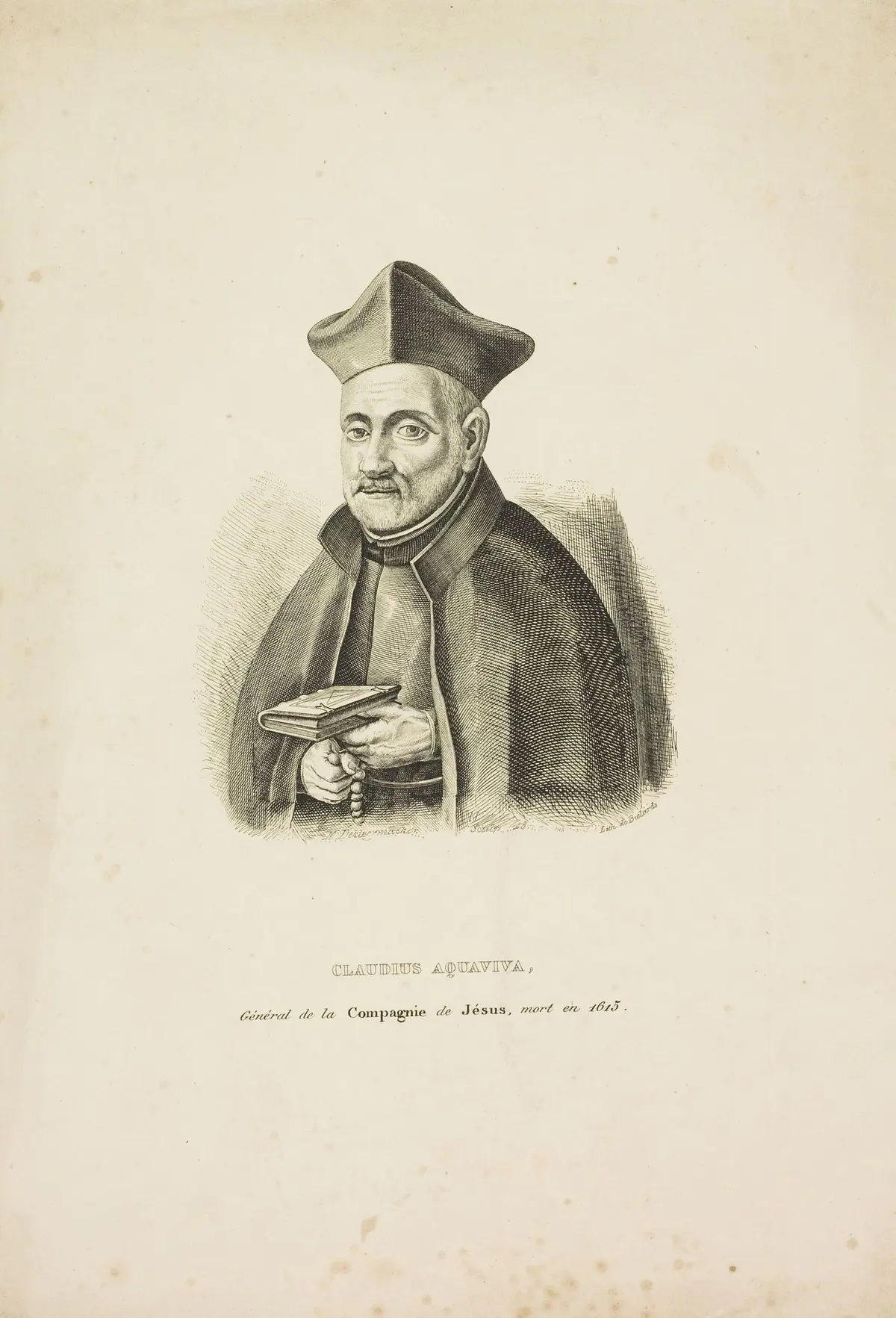
- Claudio Acquaviva (Italy), 1581–1615
- Muzio Vitelleschi (Italy), 1615–1645
- Vincenzo Carafa (Italy), 1646–1649
- Francesco Piccolomini (Italy), 1649–1651
- Alessandro Gottifredi (Italy), 1652
- Goswin Nickel (Germany), 1652–1664
- Giovanni Paolo Oliva (Italy), 1664–1681
- Charles de Noyelle (Belgium), 1682–1686
- Tirso González (Spain), 1687–1705
- Michelangelo Tamburini (Italy), 1706–1730
- Franz Retz (Bohemia), 1730–1750
- Ignazio Visconti (Italy), 1751–1755
- Luigi Centurione (Italy), 1755–1757
- Lorenzo Ricci (Italy), 1758–1775, who led the Society to its suppression in 1773 and died a prisoner in Castel Sant’Angelo
- Tadeusz Brzozowski (Poland), 1805–1820, general of the Jesuits who survived in Russia, and of the whole Society after its restoration in 1814
- Luigi Fortis (Italy), 1820–1829
- Jan Roothaan (Netherlands), 1829–1853
- Peter Jan Beckx (Belgium), 1853–1887
- Anton Anderledy (Switzerland), 1887–1892
- Luis Martín (Spain), 1892–1906
- Franz Xavier Wernz (Germany), 1906–1914
- Włodzimierz Ledóchowski (Poland), 1915–1942
- Jean-Baptiste Janssens (Belgium), 1946–1964
- Pedro Arrupe (Spain), 1965–1983
- Peter-Hans Kolvenbach (Netherlands), 1983–2008
- Adolfo Nicolás (Spain), 2008–2016
- Arturo Sosa (Venezuela), elected 2016
Some Notable Generals
Claudio Acquaviva was elected at only 38. Padberg recounts that Pope Gregory XIII was astonished at a man “yet untried in virtue and age.” Acquaviva served 34 years, the longest term in Jesuit history, and oversaw the Ratio Studiorum of 1599.
Pedro Arrupe, a Basque who had been a missionary in Japan and survived the atomic bomb at Hiroshima, led the Society through the renewal after Vatican II. He founded the Jesuit Refugee Service in 1980. A stroke in 1981 left him unable to govern, and his cause for beatification opened in 2019.
Peter-Hans Kolvenbach, a Dutch scholar of Armenian and Middle Eastern languages, had spent years in Beirut. He led the Society for 25 years and asked to resign at 79. The 35th General Congregation, which opened in January 2008, accepted his resignation and on January 19 elected Adolfo Nicolás, a Spaniard who had worked for decades in Japan and Asia.
Arturo Sosa, a Venezuelan political scientist, was elected by the 36th General Congregation on October 14, 2016, the first general from Latin America. His election came three years after a Jesuit from Argentina, Jorge Mario Bergoglio, became Pope Francis.
Continue Reading
Learn who the Jesuits are, meet the Jesuit saints and blesseds, or read the life of the first general, St. Ignatius of Loyola.
Frequently asked questions
Why is the Jesuit general called the Black Pope?
Because he wears a simple black cassock, in contrast with the pope's white, and because he leads the largest male religious order in the Church. The name is popular, not official, and Jesuits themselves rarely use it.
How is the Superior General elected?
A General Congregation of elected delegates and officials meets in Rome. After four days of prayer and private conversations called murmurationes, in which campaigning is forbidden, the delegates vote by secret ballot. A majority is needed.
What is a General Congregation?
The supreme governing body of the Society of Jesus. It meets to elect a new general or to decide major questions of Jesuit life and mission. There have been 36 since 1558.
Sources
- Constitutions of the Society of Jesus, Part IX (the Superior General)
- John W. Padberg, SJ, "General Congregations: Jesuit Governance since 1558," Company magazine (Winter 2007–2008)
- Society of Jesus, General Curia