St. Ignatius Cathedral in Shanghai: The Jesuit Church of Xujiahui
Quick answer
Xujiahui, the "Xu family village," is named after Xu Guangqi, the Ming scholar-official baptized through Matteo Ricci's mission, whose descendants remained Catholic. French Jesuits made it the center of their mission in the 19th century, with a library, an observatory, an orphanage and the Cathedral of St. Ignatius, a red-brick Gothic church completed in 1910. During the Cultural Revolution its spires were torn down and its windows destroyed. Restored from the 1980s under Jesuit Bishop Aloysius Jin Luxian, who had spent decades in prison, it received new stained-glass windows in the 2000s by artist Teresa Wo Ye that combine Chinese motifs with the Christian story.
Key takeaways
- Xujiahui is named after Xu Guangqi, an early Chinese Catholic and friend of Matteo Ricci.
- French Jesuits built the cathedral, completed in 1910.
- Its spires and stained glass were destroyed during the Cultural Revolution.
- Bishop Aloysius Jin Luxian, SJ, restored the cathedral and the diocese after his release from prison.
- New windows by Teresa Wo Ye blend Chinese art with Christian themes.
In December 2003, an American art professor boarded a plane in San Francisco carrying about 35 pieces of expensive German stained glass in his luggage. He was on his way to Shanghai to help create new windows for the Cathedral of St. Ignatius, a red-brick church built by French Jesuits. His travel journal in Company magazine opened a window onto one of the great Catholic stories of China.
The Village of the Xu Family
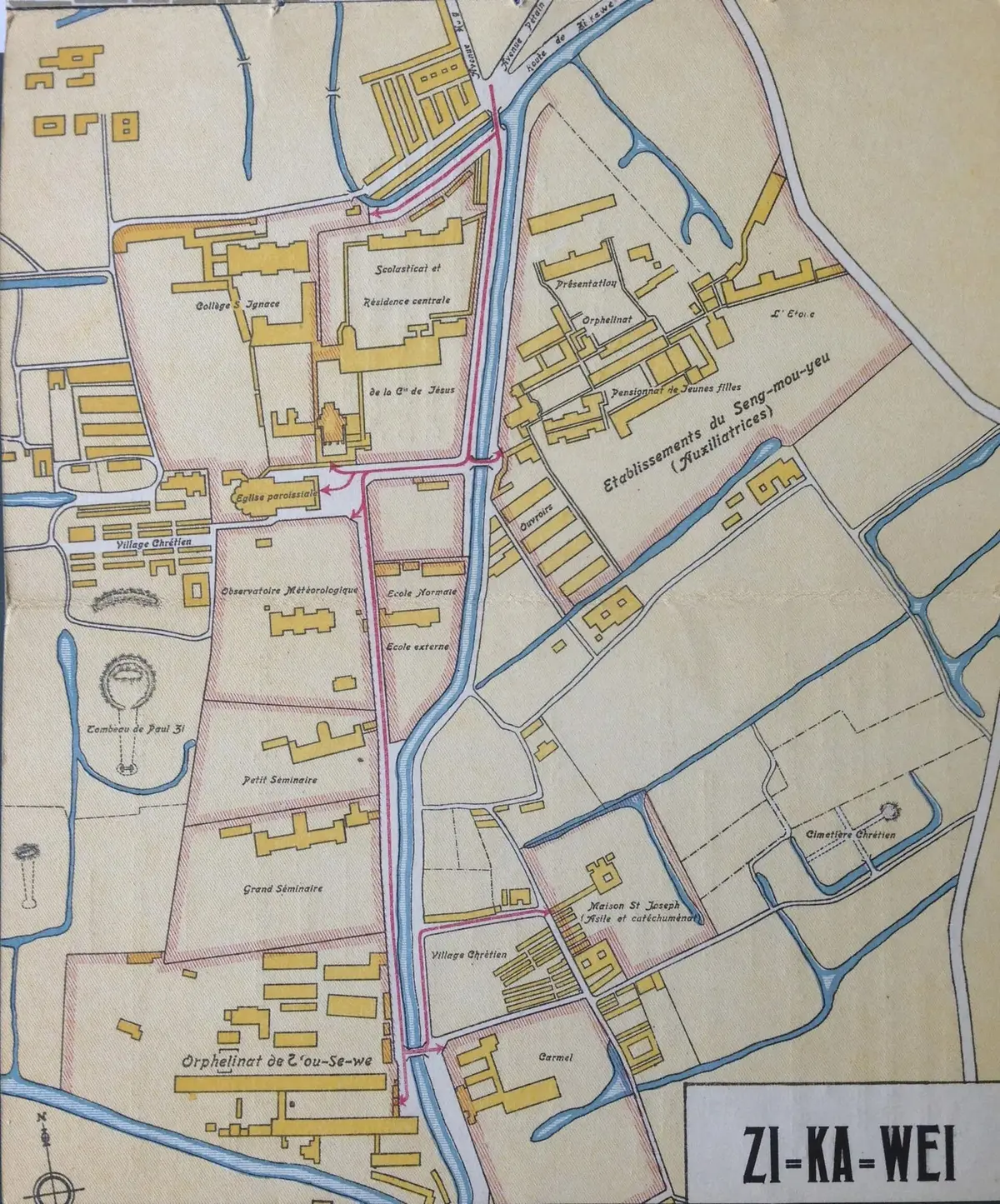
The cathedral stands in Xujiahui, the “Xu family village.” It is named after Xu Guangqi, a scholar and high official of the Ming dynasty who was baptized in 1603 with the name Paul. He was a close friend and collaborator of Matteo Ricci, with whom he translated Euclid’s geometry into Chinese. His descendants remained Catholic, and his tomb is nearby.
The French Jesuit Mission
In the 19th century, after the Jesuits returned to China, French Jesuits made Xujiahui the center of their mission. They built a famous library, a scientific observatory that issued weather and typhoon warnings for the China coast, an orphanage with workshops, schools and a seminary.
The Cathedral of St. Ignatius, a large Gothic church of red brick with two tall spires, was completed in 1910. It became one of the largest Catholic churches in China.
Destruction and Survival
After the Communist revolution, the Church in China suffered severe persecution. During the Cultural Revolution, beginning in 1966, the cathedral’s spires were pulled down, its stained-glass windows smashed and the building used as a warehouse.
Aloysius Jin Luxian, a Shanghai Jesuit, spent about 26 years in prisons and labor camps. After his release, he became rector of the reopened seminary, overseeing translations of the Vatican II documents and the liturgy into Chinese, and later served as bishop of Shanghai. Under his leadership the cathedral was restored and its spires rebuilt in the 1980s.
New Windows for an Old Church
Bishop Jin sent a young Beijing-born artist, Teresa Wo Ye, to study church art in Italy and the United States, and in 2002 entrusted to her the design of new windows for the cathedral. With three Chinese sisters who fabricated the panels and helpers from abroad, she created about 2,500 square feet of stained glass that combines traditional Western techniques with Chinese motifs and iconography, telling the Christian story in a Chinese visual language.
The project embodies the vision of Matteo Ricci, who believed the Gospel could take root in Chinese culture.
Prayer for the Church in China (Original Prayer)
Lord Jesus, You promised to be with Your Church always. Strengthen the Catholics of China in faith, hope and love. Give them freedom to worship You, unity with the Successor of Peter, and courage to witness to Your Gospel. Our Lady of Sheshan, Help of Christians, pray for China. Amen.
Continue Reading
Read about Matteo Ricci, the Chinese Rites controversy, or Jesuit astronomers in the imperial court.
Frequently asked questions
Who was Xu Guangqi?
A Ming dynasty scholar and high official (1562–1633) who was baptized as Paul in 1603 and worked with Matteo Ricci to translate Euclid into Chinese. His cause for beatification has been opened, and he is called Servant of God.
Can you visit St. Ignatius Cathedral in Shanghai?
Yes. The cathedral in Xujiahui is open to visitors outside of Mass times, and it remains an active parish and the cathedral of the Diocese of Shanghai.
Sources
- "Shanghai Journal," Company magazine (Winter 2004–2005)
- Jean-Paul Wiest, "Bringing Christ to the Nations, Shifting Models of Mission Among Jesuits in China," Catholic Historical Review (2003)
- Aloysius Jin Luxian, SJ, The Memoirs of Jin Luxian (Hong Kong University Press, 2012)