Jesuit Astronomers: Priests Who Studied the Stars
Quick answer
Jesuits have studied the heavens since the 16th century. Christopher Clavius helped reform the calendar, Christoph Scheiner studied sunspots, Giovanni Battista Riccioli named many features of the Moon, and Jesuits such as Johann Adam Schall von Bell and Ferdinand Verbiest directed the imperial observatory in Beijing. In the 19th century Angelo Secchi pioneered the classification of stars by their spectra. Today Jesuits run the Vatican Observatory, and about 35 craters on the Moon are named after Jesuit scientists.
Key takeaways
- Jesuit schools made mathematics and astronomy core subjects from the 1500s.
- Clavius, Scheiner, Grimaldi and Riccioli were leading astronomers of their day.
- Jesuits led the imperial astronomical bureau in Beijing for much of the 17th and 18th centuries.
- Angelo Secchi was a pioneer of astrophysics and stellar spectroscopy.
- The Vatican Observatory, run by Jesuits, operates a telescope in Arizona.
Chicago’s Adler Planetarium holds one of the world’s great collections of antique astronomy books. A curator who spent a decade with them wrote in Company magazine that a surprising number were written by Jesuits. Why? Because for centuries, Jesuit scientists “investigated the world around them incessantly,” and in no field did they achieve more than in astronomy.
Why Jesuits Looked to the Stars
St. Ignatius taught his followers to find God in all things. The Jesuits’ plan of studies, the Ratio Studiorum, made mathematics and natural philosophy part of every serious education. Astronomy was useful too: it was needed for the calendar, for navigation and for mapmaking, and in China it opened the doors of the imperial court.
The Great Jesuit Astronomers
Christopher Clavius (1538–1612)
The mathematician of the Roman College who helped create and defend the Gregorian calendar. His textbooks trained generations of Jesuits, including Matteo Ricci.
Christoph Scheiner (1573–1650)
A German Jesuit who made careful telescopic observations of sunspots from 1611 and wrote a major work on the Sun’s rotation, Rosa Ursina. He quarreled with Galileo over who saw them first.
Giovanni Battista Riccioli (1598–1671) and Francesco Maria Grimaldi (1618–1663)
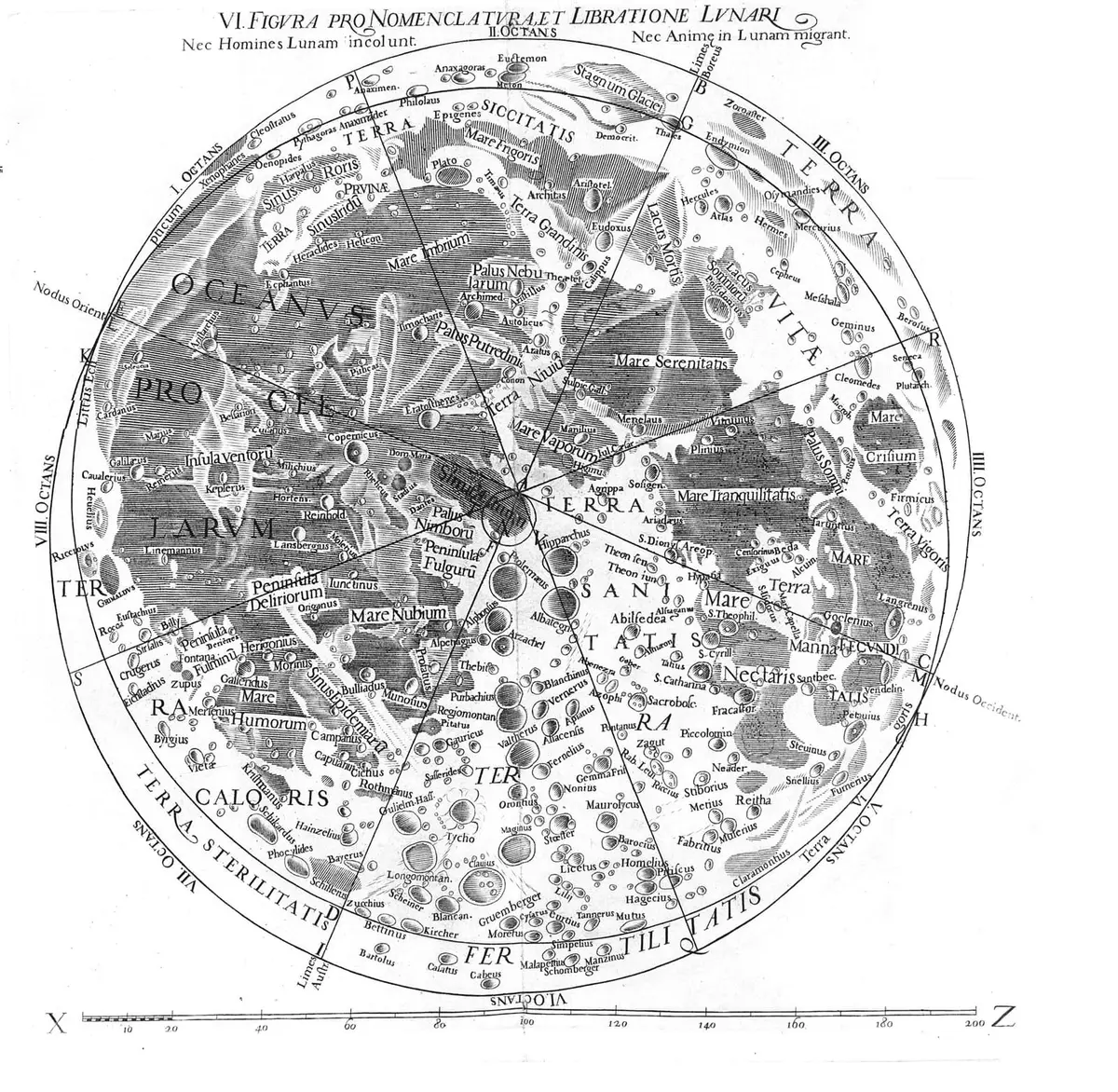
In 1651 Riccioli published a great astronomy textbook, the Almagestum Novum, with a map of the Moon drawn with Grimaldi. They named the craters after astronomers and philosophers, and the seas after weather and moods, such as the Sea of Tranquility. Many of their names are still used, which is why Apollo 11 landed in the Mare Tranquillitatis. Grimaldi also discovered the diffraction of light.
The Jesuits of Beijing
Matteo Ricci won respect in China partly through his knowledge of mathematics and astronomy. His successors Johann Adam Schall von Bell and Ferdinand Verbiest predicted eclipses more accurately than the court astronomers and directed the imperial Bureau of Astronomy. Verbiest rebuilt the instruments of the Beijing Ancient Observatory in the 1670s; some can still be seen today.
Athanasius Kircher (1602–1680)
The universal genius of the Roman College, who wrote on magnetism, optics, volcanoes, music and Egyptian hieroglyphs. Read his story: Athanasius Kircher, the Last Renaissance Man.
Angelo Secchi (1818–1878)
Director of the Roman College observatory, Secchi was one of the founders of astrophysics. He sorted stars into classes by their spectra, the first such classification, and studied the Sun, solar eclipses and weather.
Benito Viñes (1837–1893)
From the Jesuit observatory in Havana, the “Father of Hurricanes” issued some of the first scientific hurricane warnings.
The Vatican Observatory
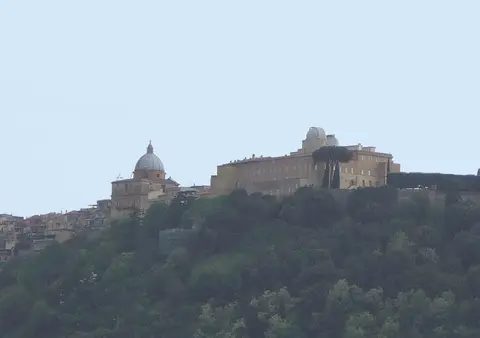
The Vatican Observatory, founded in its modern form by Pope Leo XIII in 1891, is staffed mainly by Jesuits. Its headquarters moved to Castel Gandolfo in the 1930s, and since 1993 it has operated the Vatican Advanced Technology Telescope on Mount Graham in Arizona. Jesuit astronomers there study meteorites, asteroids, galaxies and cosmology. In the 1990s a Seattle University engineer, Fr. Bert Otten, SJ, who had worked with that telescope, spent a sabbatical building solar panels for the Jesuit Refugee Service in Angola.
Craters and Asteroids
About 35 craters on the Moon honor Jesuit scientists, from Clavius, one of the largest, to Scheiner, Riccioli, Grimaldi, Secchi and Kircher. Asteroids bear Jesuit names too: in 2005 JesuitUSA News reported an asteroid named for a Jesuit astronomer.
Faith and Science
The Catechism teaches that faith and reason cannot truly contradict each other, “since the same God who reveals mysteries and infuses faith has bestowed the light of reason on the human mind” (CCC 159). The Jesuit astronomers lived that conviction.
Prayer of a Stargazer (Psalm 8:3–5)
When I look at your heavens, the work of your fingers, the moon and the stars which you have established; what is man that you are mindful of him, and the son of man that you care for him? Yet you have made him little less than God, and crowned him with glory and honor.
Continue Reading
Read about the Gregorian calendar, Athanasius Kircher, or Jesuit education.
Frequently asked questions
Why were there so many Jesuit scientists?
The Jesuits believed one could "find God in all things," including nature. Their schools taught mathematics and natural science, and their missionaries used astronomy to win respect, especially in China.
How many lunar craters are named after Jesuits?
About 35, including Clavius, Scheiner, Riccioli, Grimaldi, Secchi and Kircher. Riccioli and Grimaldi drew the lunar map of 1651 that gave the Moon's features many of the names still used.
Does the Vatican still have an observatory?
Yes. The Vatican Observatory, staffed mainly by Jesuits, has headquarters at Castel Gandolfo near Rome and operates the Vatican Advanced Technology Telescope on Mount Graham in Arizona.
Sources
- "Right Off the Shelf," Company magazine (Winter 2004–2005), on Jesuit books at the Adler Planetarium
- Agustín Udías, SJ, Jesuit Contribution to Science (Springer, 2015)
- Vatican Observatory