St. Augustine of Hippo: Life, Conversion, Feast Day (August 28) and Prayer
Quick answer
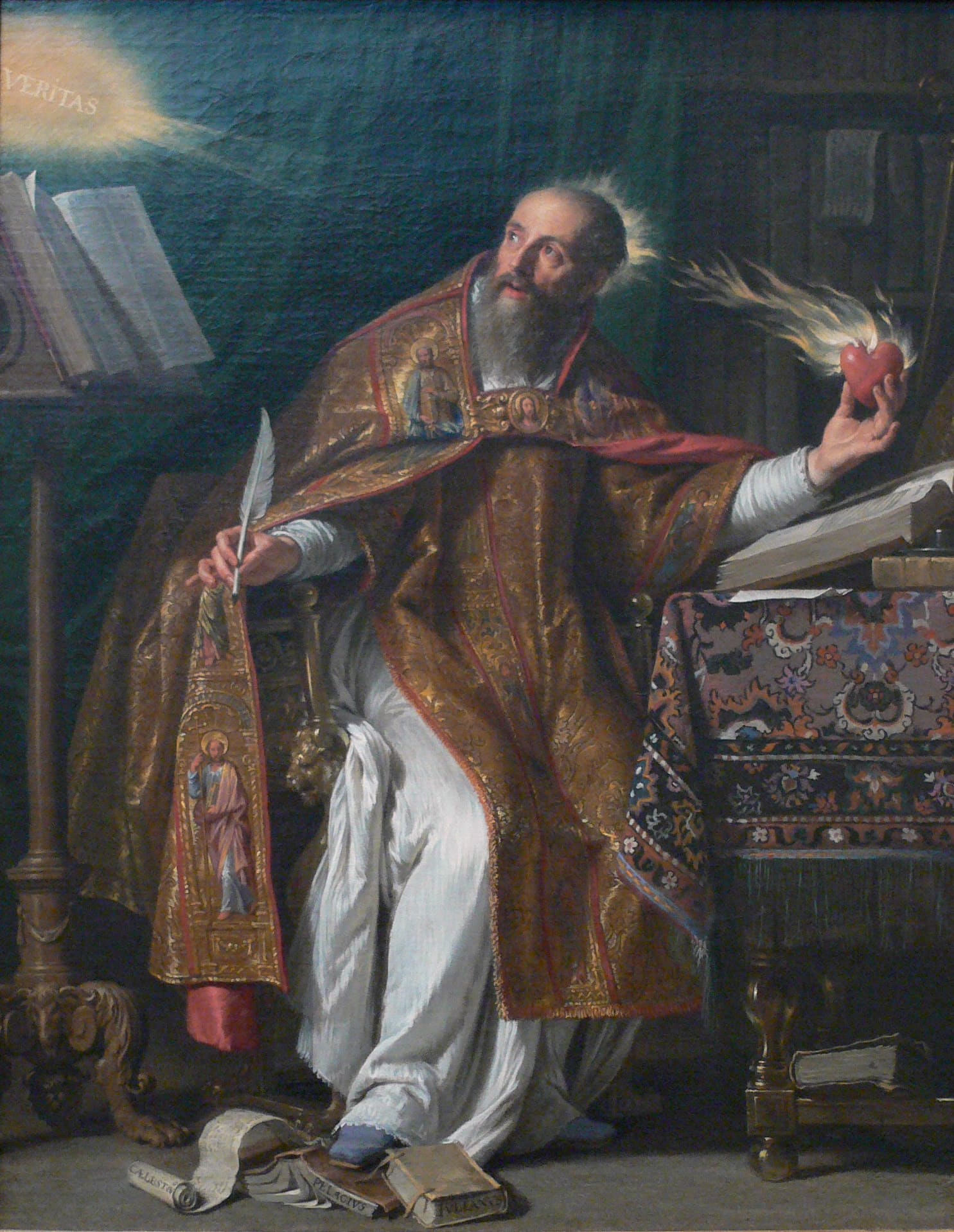
St. Augustine of Hippo (354–430) was a brilliant North African teacher who, after years of searching and sin, was converted in Milan in 386 and baptized by St. Ambrose in 387. As bishop of Hippo he wrote the Confessions and The City of God. He is a Doctor of the Church, and his feast is August 28.
Key takeaways
- Augustine was born on November 13, 354, at Tagaste in North Africa, the son of a pagan father, Patricius, and a Christian mother, St. Monica.
- For years he followed the Manichaean sect and lived with a woman outside marriage, with whom he had a son, Adeodatus.
- He was converted in a garden in Milan in 386, and St. Ambrose baptized him at Easter in 387.
- As bishop of Hippo he served his people for more than thirty years and wrote the Confessions and The City of God.
- He died on August 28, 430, while the Vandals were besieging Hippo.
Few saints are as easy to relate to as St. Augustine. He knew what it was to chase success, to give in to temptation, to break his mother’s heart, and to feel restless no matter what he achieved. Then God caught up with him, and he became one of the greatest teachers in the history of the Church.
A Restless Youth in North Africa
Augustine was born on November 13, 354, at Tagaste, in what is now Algeria. His father, Patricius, was a pagan who became a Christian shortly before he died. His mother, St. Monica, was a devout Catholic who never stopped praying for her son.
He was gifted, and his family made sacrifices to send him to study at Carthage. There he found the excitement of a big city and began living with a woman outside marriage. Their son, Adeodatus, whose name means “given by God,” was born around 372.
At nineteen he read a work by the Roman author Cicero that set him on fire with the love of wisdom. He turned to the Bible but found it plain and unimpressive. He joined the Manichaeans, a sect that claimed to explain the world through a battle between good and evil powers. He stayed with them for about nine years.
Monica’s Tears
Monica wept and prayed for years. A bishop she begged for help is said to have comforted her with words Augustine later recorded in the Confessions: the son of so many tears would not be lost.
When Augustine sailed for Rome in 383, he slipped away from her by a trick. She followed him anyway. He moved on to Milan to teach rhetoric, and it was there that the turning point came.
Conversion in a Garden
In Milan, Augustine went to hear the bishop, St. Ambrose, at first simply to study his speaking style. Little by little, the content of the sermons began to reach him. Ambrose showed him that the Scriptures had depths he had never suspected.
By 386 he believed but could not bring himself to change his life. In a garden in Milan, weeping in anguish, he heard the voice of a child chanting “Take up and read.” He opened the letters of St. Paul and read these words:
Not in rioting and drunkenness, not in chambering and impurities, not in contention and envy: but put ye on the Lord Jesus Christ, and make not provision for the flesh in its concupiscences. (Romans 13:13-14, Douay-Rheims)
He later wrote that a light of peace flooded his heart. St. Ambrose baptized him, along with Adeodatus, at the Easter Vigil of 387.
Soon afterward, at the port of Ostia, Monica told him that her life’s work was done. She died there, her prayers answered.
Priest and Bishop of Hippo
Augustine returned to Africa, hoping to live quietly in a community of friends given to prayer and study. Adeodatus died young during these years. In 391, on a visit to the port city of Hippo, Augustine was recognized by the people and pressed into the priesthood. Within a few years he became its bishop.
He served Hippo for more than thirty years. He preached constantly, settled disputes, cared for the poor, and lived in community with his clergy. His guidelines for that common life, known as the Rule of St. Augustine, are still followed by religious orders today.
He also defended the faith in the great controversies of his age. Against the Donatists, he argued for the unity of the Church. Against the Pelagians, he taught that we cannot save ourselves and that we depend on God’s grace for every good thing.
His Great Writings
Augustine left an enormous body of work. Three books stand out:
- The Confessions (around 400), the story of his life told as a prayer to God.
- On the Trinity, a long meditation on the mystery of the one God in three Persons.
- The City of God (413–426), written after the sack of Rome in 410, which contrasts the passing city of this world with the eternal City of God.
Two lines from the Confessions have comforted believers for sixteen centuries. The first opens the book: “You have made us for yourself, and our heart is restless until it rests in you” (CCC 30). The second is his cry of regret and love, “Late have I loved you.”
His Final Days
In 430 the Vandals laid siege to Hippo. Augustine, now 75, fell ill and had the penitential psalms hung on the wall where he could read them from his bed. He died on August 28, 430. He is honored as one of the great Doctors of the Latin Church.
Prayer to the Holy Spirit (Traditionally Attributed to St. Augustine)
Breathe in me, O Holy Spirit, that my thoughts may all be holy. Act in me, O Holy Spirit, that my work, too, may be holy. Draw my heart, O Holy Spirit, that I love but what is holy. Strengthen me, O Holy Spirit, to defend all that is holy. Guard me, then, O Holy Spirit, that I always may be holy. Amen.
A Prayer for Those Who Have Left the Faith (Original Prayer)
St. Augustine and St. Monica, you know how long the road home can be. Pray for my loved ones who have wandered from God. Give me patience and hope, and let my tears become prayers. May our restless hearts find their rest in Him. Amen.
Continue Reading
You may also like the lives of St. Leo the Great, another great teacher of the early Church, and St. Charles Borromeo. If you are thinking about returning to the sacraments, our guide on how to go to confession will help you take the first step.
Frequently asked questions
When is the feast day of St. Augustine?
His feast is August 28, the day of his death in 430. The memorial of his mother, St. Monica, is celebrated the day before, on August 27.
What is St. Augustine the patron saint of?
He is widely regarded as a patron of theologians and of brewers, and many people who are struggling to turn back to God ask his prayers. Parents of children who have left the faith often pray to him and to St. Monica together.
What is St. Augustine's most famous quote?
The best known comes from the opening of the Confessions, quoted in the Catechism: "You have made us for yourself, and our heart is restless until it rests in you" (CCC 30).
What should I read first by St. Augustine?
Start with the Confessions. It is written as one long prayer to God, it tells the story of his conversion, and it remains very moving. The City of God is much longer and is better taken up later.
Was Pope Leo XIV connected to St. Augustine?
Yes. Pope Leo XIV belongs to the Order of St. Augustine, and the Vatican describes him as the first Augustinian pope in the history of the Church.
Sources
- St. Augustine, Confessions
- Catechism of the Catholic Church 30
- Romans 13:13-14
- Biography of the Holy Father Leo XIV (Holy See)