Pope St. Leo the Great: Life, Feast Day (November 10) & Prayer
Quick answer
Pope St. Leo the Great (died 461) led the Church from 440 to 461. He defended the truth that Jesus Christ is one Person, truly God and truly man, in his famous Tome, which the Council of Chalcedon accepted in 451. He met Attila the Hun in 452, is a Doctor of the Church, and his feast is November 10.
Key takeaways
- St. Leo the Great was pope from 440 until his death on November 10, 461; his memorial is kept on November 10.
- His Tome of 449 explained that Christ is one divine Person in two natures, divine and human, and the Council of Chalcedon accepted it in 451.
- In 452 he met Attila the Hun in northern Italy, and Attila withdrew; in 455 he persuaded the Vandal king Genseric to spare the lives of the people of Rome.
- He is one of only two popes the Church widely calls 'the Great', and Pope Benedict XIV declared him a Doctor of the Church in 1754.
- His sermons, quoted in the Catechism, remind every Christian: 'Christian, recognize your dignity' (CCC 1691).
Pope St. Leo the Great led the Catholic Church from 440 to 461, in one of the most troubled times in its history. He gave the Church a clear statement of faith that Jesus Christ is one Person, truly God and truly man, and he faced down invaders to protect the people of Rome. The Church celebrates his feast on November 10, and he is honored as a Doctor of the Church.
Who Was Pope St. Leo the Great?
Leo lived when the Western Roman Empire was falling apart. Barbarian armies crossed the frontiers, emperors were weak, and the Church was divided by arguments about who Jesus Christ really is. Into this storm God sent a pope with a clear mind, a steady heart and a gift for words.
We know little about his early years. He was born around the year 400, probably in Tuscany, though some early sources say Rome. By the 430s he was a deacon of the Roman Church, trusted by Pope Celestine I and Pope Sixtus III. He was already respected enough that the monk John Cassian wrote a book on the Incarnation at his request.
In 440 Leo was away in Gaul (modern France) on a delicate mission to make peace between two Roman generals. While he was there, Pope Sixtus III died, and the Roman clergy and people chose Leo as his successor. He returned to Rome and was consecrated bishop on September 29, 440. He was the first pope to take the name Leo.
Key Dates in the Life of St. Leo the Great
| Year | Event |
|---|---|
| c. 400 | Born, probably in Tuscany |
| 430s | Deacon of the Roman Church |
| 440 | Elected pope while on a mission in Gaul; consecrated September 29 |
| 449 | Sends his Tome to Bishop Flavian of Constantinople |
| 451 | The Council of Chalcedon accepts his teaching on Christ |
| 452 | Meets Attila the Hun in northern Italy; Attila withdraws |
| 455 | Persuades the Vandal king Genseric to spare the lives of the Romans |
| 461 | Dies in Rome on November 10; buried at St. Peter’s |
| 1754 | Declared a Doctor of the Church by Pope Benedict XIV |
Why Is He Called “the Great”?
Only two popes have long been called “the Great” by the whole Church: Leo I and Gregory I, who lived about 150 years later. Leo earned the title in two ways.
First, he was a great teacher. When false ideas about Christ threatened to tear the Church apart, he explained the faith so clearly that bishops from East and West recognized in his words the faith of the Apostles.
Second, he was a great shepherd. When armies came to Rome and the emperors could not protect the city, the pope went out to meet them. He did not carry a sword, only his faith and his office.
The Tome of Leo: Christ Is True God and True Man
The great question of Leo’s day was how Jesus can be both God and man. A monk in Constantinople named Eutyches taught that after the Incarnation, Christ had only one nature, as if His humanity had been swallowed up by His divinity. That would mean Jesus was not truly one of us.
In 449 Leo wrote a long letter to Flavian, the Bishop of Constantinople, which became known as the Tome of Leo. In it he taught that Christ is one Person, the eternal Son of God, who has two complete natures, divine and human. Each nature keeps what belongs to it, and both are united in the one Christ. As God, He works miracles; as man, He hungers, weeps and dies. Yet it is the same Lord who does both.
That same year, a council at Ephesus was dominated by supporters of Eutyches. Leo’s letter was not even allowed to be read, and Flavian was treated so roughly that he died soon after. Leo refused to accept the meeting and called it a latrocinium, a “robbers’ council.”
The Council of Chalcedon (451)
Two years later, a new council met at Chalcedon, near Constantinople. More than five hundred bishops attended, most of them from the East. Leo’s Tome was read aloud, and according to the acts of the council, the bishops cried out that this was the faith of the Fathers and that Peter had spoken through Leo.
The council then defined the faith that the Church still professes: Jesus Christ is “perfect in divinity and perfect in humanity,” one and the same Son, made known “in two natures without confusion, change, division or separation” (CCC 467). Every time we pray the Creed and confess that the Son of God “became man,” we stand on the ground Leo helped to secure. (For a simple overview, see what Catholics believe about Jesus.)
St. Leo the Great and Attila the Hun
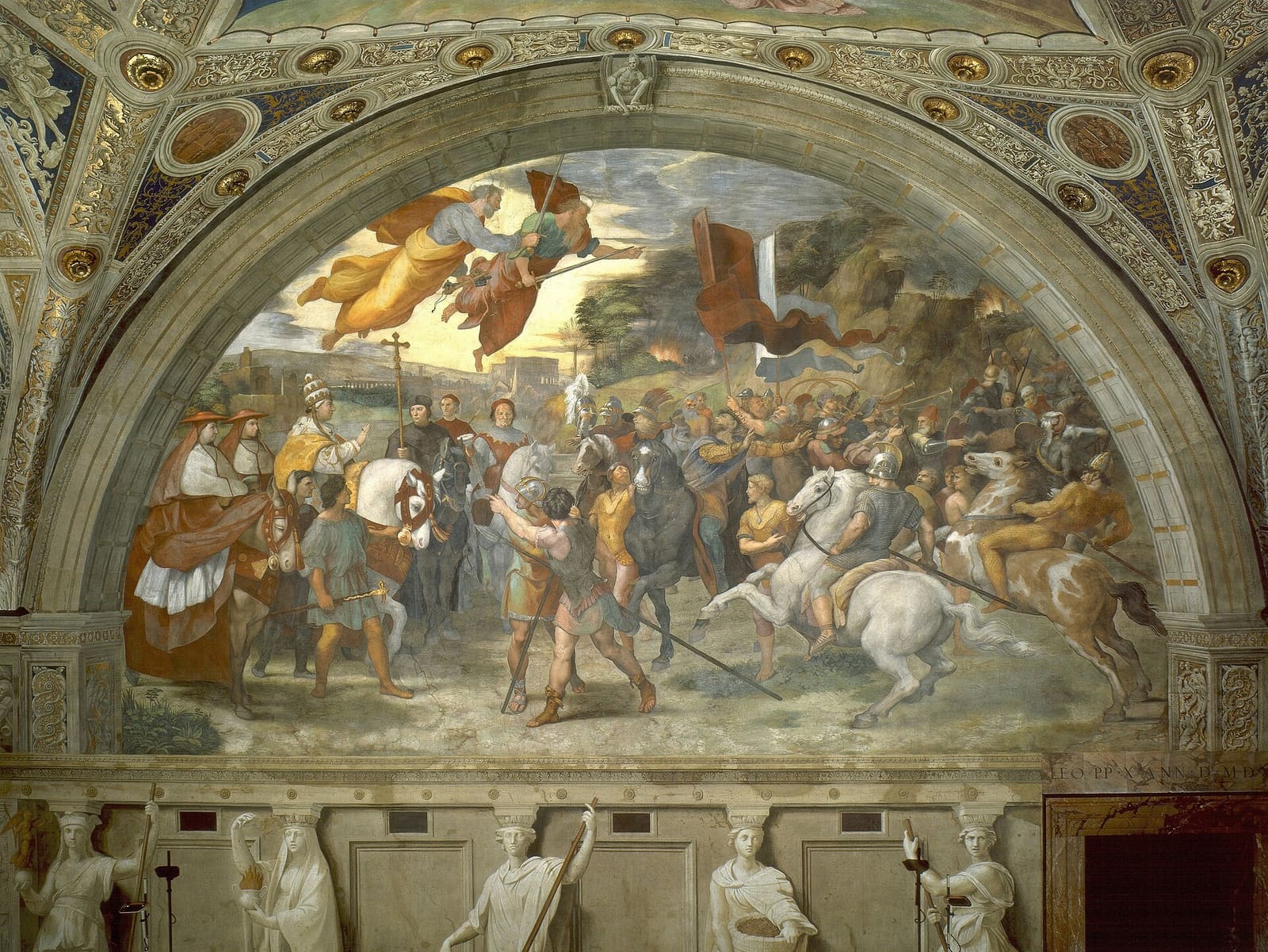
In 452 Attila, king of the Huns, invaded northern Italy. Cities such as Aquileia were destroyed, and Rome lay open before him. The emperor sent Pope Leo, with two leading Roman officials, to meet the invader. They met Attila near Mantua, in northern Italy.
After the meeting, Attila turned back and left Italy. Historians still discuss why. His army was also suffering from disease and lack of food, so the pope’s words were probably not the only reason. Yet the people of Rome remembered that their bishop had gone out to face the danger when others could not.
A later legend tells that Sts. Peter and Paul appeared in the sky above Leo, armed with swords, and that this frightened Attila. This is pious tradition, not history. It is best known from Raphael’s fresco in the Vatican Palace, and a great marble relief by Alessandro Algardi shows the scene above Leo’s altar in St. Peter’s Basilica.
Leo and the Vandals (455)
Three years later a new danger came by sea. Genseric, king of the Vandals, sailed from North Africa and reached Rome in 455. This time Leo could not keep the enemy out of the city, and the Vandals plundered Rome for two weeks.
But the pope went to meet Genseric and persuaded him to spare the people’s lives and not to burn the city. Leo then worked to care for the poor and rebuild what had been lost. He shows us that a shepherd does not abandon his flock, even when he cannot prevent every harm.
Leo the Preacher and Pastor
Leo was above all the bishop of Rome, and he preached regularly to his own people. Nearly a hundred of his sermons survive, along with many letters. They are short, clear and beautiful, written to be heard by ordinary Christians. He preached on Christmas and the Epiphany, on Lent and Easter, on fasting and almsgiving, and on the feasts of the Apostles.
His best-known words come from a Christmas sermon, and the Catechism quotes them:
“Christian, recognize your dignity and, now that you share in God’s own nature, do not return to your former base condition by sinning. Remember who is your head and of whom you are a member.” (CCC 1691)
In another sermon, on the Ascension, he taught that “what was visible in our Savior has passed over into his mysteries” (CCC 1115). In other words, Jesus still touches us today through the sacraments. These are good words to carry into the coming season, as Advent begins on November 29, 2026 and we prepare again for the feast of the Incarnation he loved to preach about.
Leo and the Office of Peter
Leo had a deep sense of what it means to be the successor of St. Peter. He often preached on the words of Jesus: “you are Peter, and upon this rock I will build my church” (Matthew 16:18). He taught that Peter keeps watching over the Church through the ministry of the bishop of Rome.
For Leo this was never about personal honor. He called himself unworthy, and he saw his office as a service to unity and to the truth about Christ. Pope Benedict XVI, in a general audience on St. Leo the Great in 2008, held him up as a pope who served the truth in a time of crisis. (You can read more about why Catholics pray to St. Peter.)
His Death and Burial
Leo died in Rome on November 10, 461, after more than twenty-one years as pope. He was buried at St. Peter’s, and his relics rest in the basilica today beneath the altar that bears his name.
In 1754 Pope Benedict XIV declared him a Doctor of the Church, a title given to saints whose teaching has greatly served the whole Church. He shares that title with saints such as Augustine, Thomas Aquinas and Thérèse of Lisieux.
What Is Pope St. Leo the Great the Patron Saint Of?
The Church has never given St. Leo an official patronage. But Catholics naturally ask his prayers for the things he loved and served:
- The pope and the bishops, that they may teach the faith clearly and with courage.
- The unity of the Church, East and West.
- Faithfulness to the truth about Christ, especially in times of confusion.
- Cities and nations in danger, remembering how he faced Attila and Genseric.
- Preachers and teachers of the faith, who can learn from his clear, simple sermons.
Pope St. Leo the Great Feast Day: How to Celebrate November 10
St. Leo’s feast is an obligatory memorial in the General Roman Calendar, celebrated every year on November 10, the day of his death. (In the older calendar, still used for the Traditional Latin Mass, his feast is April 11.) Here are some simple ways to keep the day:
- Go to Mass if you can, and listen for his name in the prayers.
- Pray for the pope, Pope Leo XIV, who bears the same name.
- Pray the Nicene Creed slowly, thinking about the words “and became man.”
- Read one of his sermons. His Christmas and Lenten sermons are short and easy to read.
- Do a work of mercy for someone in need, as he did for the people of Rome after the Vandal sack.
Prayer to Pope St. Leo the Great
Collect for the Memorial of Pope St. Leo the Great (Roman Missal)
O God, who never allow the gates of hell
to prevail against your Church,
firmly founded on the apostolic rock,
grant her, we pray, through the intercession of Pope Saint Leo,
that she may stand firm in your truth
and know the protection of lasting peace.
Through our Lord Jesus Christ, your Son,
who lives and reigns with you in the unity of the Holy Spirit,
God, for ever and ever.
Amen.
Prayer for the Intercession of St. Leo the Great (Original Prayer)
St. Leo the Great,
faithful shepherd and teacher of the Church,
you proclaimed that Jesus Christ is true God and true man,
and you stood firm when others were afraid.
Pray for our Holy Father, Pope Leo XIV,
and for all who teach the faith.
Help me to remember my dignity as a child of God,
to turn away from sin,
and to love Christ in His Church and in the poor.
Obtain for us the grace of courage and peace.
Through Christ our Lord.
Amen.
What Can We Learn from St. Leo the Great Today?
Know your faith and love it. Leo did not treat the truth about Jesus as an argument for scholars only. He knew that if Christ is not truly God and truly man, He cannot save us. We honor Leo when we take the time to understand what we profess in the Creed.
Remember your dignity. His famous words, “Christian, recognize your dignity,” speak to every age, including our own. Through Baptism we share in God’s life. Sin is not freedom; it is a return to slavery.
Courage can be calm. Leo faced Attila with no army. He trusted God and did his duty. Many of us face our own fears: illness, loss, a world that seems to be coming apart. Leo shows that faith does not remove every danger, but it gives us the strength to stand.
Serve the people in front of you. For all his teaching, Leo was a pastor who preached to his flock, cared for the poor and rebuilt after disaster. Like St. Charles Borromeo a thousand years later, he shows that great reform begins with faithful daily service.
Pray with the saints. Leo is not only a figure of history. He lives in Christ and still prays for the Church he served. If you wonder why Catholics ask the saints for help, see why Catholics pray to saints.
Pope St. Leo the Great, pray for us.
Frequently asked questions
When is the feast day of Pope St. Leo the Great?
His feast is November 10, the day of his death in 461. It is an obligatory memorial in the General Roman Calendar, so it is celebrated at Mass throughout the Church unless it falls on a Sunday. Before the calendar reform of 1969 his feast was kept on April 11, and the older calendar still keeps that date.
What is Pope St. Leo the Great the patron saint of?
The Church has never assigned him an official patronage, as it has for some saints. Catholics naturally ask his prayers for the pope, for the unity of the Church and for faithfulness to true teaching about Christ, because those were the great works of his life. Some also ask his help in times of danger to their city or country, remembering how he faced Attila.
Why is Pope Leo I called 'the Great'?
He earned the title through his teaching and his courage. He gave the Church a clear statement of faith in Christ, true God and true man, at a time of serious confusion, and he protected the people of Rome when the Western Empire was collapsing. He and Pope St. Gregory I are the two popes the Church has long called 'the Great'.
Did Pope Leo the Great really stop Attila the Hun?
In 452 Leo went north with a delegation from Rome and met Attila near Mantua. Attila then withdrew from Italy. Historians debate how much Leo's words mattered, since Attila's army also faced disease and shortages. A later legend says Sts. Peter and Paul appeared above the pope; that story is pious tradition, best known through Raphael's fresco in the Vatican.
Is Pope Leo XIV named after St. Leo the Great?
Pope Leo XIV, elected May 8, 2025, explained that he chose his name mainly in reference to Pope Leo XIII and his teaching on the dignity of workers. Still, every Pope Leo stands in a line that begins with St. Leo the Great, the first pope to take the name and one of the most important teachers in the Church's history.
Sources
- Catechism of the Catholic Church 467, 1115, 1691
- Matthew 16:13-19
- Pope Benedict XVI, General Audience on St. Leo the Great (March 5, 2008)
- Roman Missal, Memorial of Pope St. Leo the Great, November 10
- Catholic Encyclopedia (1910), Pope St. Leo I (the Great)