Jesuit Chaplains: Priests on the Battlefield and in the Hospital
Quick answer
Jesuits have served as chaplains for centuries, following St. Ignatius's own care for the sick and dying. Irish Jesuit Fr. Willie Doyle was killed in 1917 while ministering to soldiers at Passchendaele. U.S. Navy chaplain Fr. Joseph O'Callahan received the Medal of Honor for saving lives aboard the USS Franklin in 1945. In recent decades Jesuits such as Fr. Jack McLain served with the 82nd Airborne and Special Forces in Kosovo, Africa and Afghanistan, while Jesuit chaplains have served at Chicago's Cook County Hospital since 1902. Their ministry brings the sacraments, prayer and presence to people in crisis.
Key takeaways
- Chaplains bring the sacraments and pastoral care to soldiers, patients and prisoners.
- Fr. Willie Doyle, SJ, died serving Irish soldiers at Passchendaele in 1917.
- Fr. Joseph O'Callahan, SJ, received the Medal of Honor for heroism on the USS Franklin.
- Fr. Jack McLain, SJ, served six years as an Army chaplain with the 82nd Airborne.
- Jesuits have served as chaplains at Cook County Hospital in Chicago since 1902.
St. Ignatius sent his first companions to care for the sick in the hospitals of Venice and Rome, and he asked every Jesuit novice to spend a month serving in a hospital. Ever since, Jesuits have gone where people suffer and die: to battlefields, warships, emergency rooms and prisons. These are some of their stories.
Fr. Willie Doyle and the Trenches
Fr. William Doyle, SJ, an Irish Jesuit, volunteered as a chaplain to Irish soldiers in World War I. He crawled into no-man’s-land to anoint the dying and gave absolution under shellfire. On August 16, 1917, at the Battle of Passchendaele in Belgium, he was killed while going to help wounded men. Soldiers of every faith mourned him, and many Catholics hope for his canonization.
Fr. Joseph O’Callahan and the USS Franklin
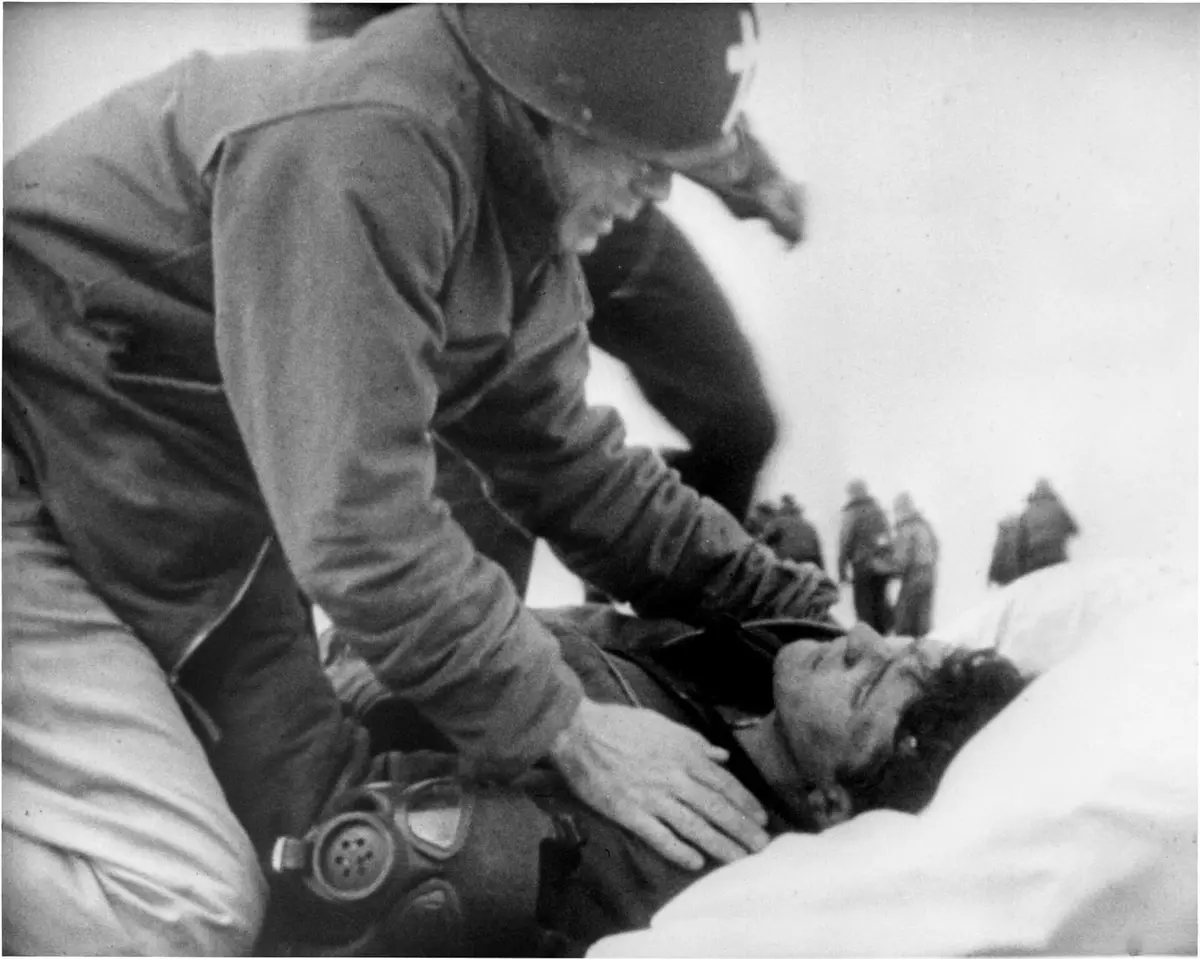
On March 19, 1945, Japanese bombs struck the aircraft carrier USS Franklin off Japan, setting off fires and explosions that killed more than 800 men. The ship’s Catholic chaplain, Fr. Joseph O’Callahan, SJ, a former mathematics professor at Holy Cross, moved through the burning decks anointing the dying, leading firefighting crews and helping throw live ammunition overboard. He received the Medal of Honor, the first chaplain to receive it in World War II. He told the story in his book I Was Chaplain on the Franklin.
“Captain Jack”: A Paratrooper Priest
In recent decades, Fr. Jack McLain, SJ, served six years as an Army chaplain at Fort Bragg, North Carolina, with the 82nd Airborne and the Special Forces. His tours took him to Kosovo, West Africa, Mali and, after September 11, twice to Afghanistan. Company magazine described a priest who jumped out of airplanes, loved rock music and could advise video gamers, yet whose heart was in celebrating the Eucharist, baptisms, weddings and funerals for soldiers. “He knows exactly where God is in the middle of a war zone,” the magazine wrote.
On Call at Cook County Hospital
Not all chaplains wear uniforms. Since 1902, at the request of the Archdiocese of Chicago, Jesuits have served at Cook County Hospital, which cares for the city’s poor. Company followed Fr. John Pennington, SJ, through a day that began with finding the family of a badly burned two-year-old boy and praying with them outside the burn unit. “Where it happens, you pray,” he said. His colleague Fr. Robert Finn called it “a work for and with the poor” and “a chance to see our Lord at work among his people.”
Fr. Pennington’s vocation as a chaplain began with grief: years earlier, he had been unable to reach his own dying mother, and he resolved that others should not die alone.
The Ministry of Presence
The Church entrusts chaplains with the sacraments of healing: Confession and the Anointing of the Sick, as well as Viaticum, Communion for the dying. The Catechism teaches that the anointing gives “strengthening, peace and courage” to overcome the difficulties of serious illness or old age (CCC 1520). Above all, chaplains offer presence: the sign that God has not abandoned anyone.
Prayer for Chaplains (Original Prayer)
Lord Jesus, Good Shepherd, bless all chaplains who serve in war zones, hospitals, prisons and places of suffering. Give them courage in danger, compassion for the dying and strength when they are weary. Through their hands, bring Your mercy and peace to all who are in need. Amen.
Continue Reading
Read about Fr. Browne, the Jesuit who photographed the Titanic and served as a World War I chaplain, the Jesuit martyrs of the 20th century, or St. Aloysius Gonzaga.
Frequently asked questions
What does a Catholic chaplain do?
A chaplain celebrates Mass, hears confessions, anoints the sick and dying, baptizes, counsels and simply stays present with people in hospitals, the military, prisons, schools and other institutions where they cannot easily reach a parish.
Which Jesuit chaplain received the Medal of Honor?
Fr. Joseph T. O'Callahan, SJ, a Navy chaplain and former professor at Holy Cross, received the Medal of Honor for his actions after the aircraft carrier USS Franklin was bombed on March 19, 1945. He was the first chaplain to receive it in World War II.
Sources
- "Captain Jack McLain, SJ," Company magazine (Spring 2005)
- Deanna Bellandi, "On Call," Company magazine (Spring 2001)
- Joseph T. O'Callahan, SJ, I Was Chaplain on the Franklin (1956)
- Catechism of the Catholic Church, nos. 1499–1532 (Anointing of the Sick)