The Jesuits in Vietnam: From Alexandre de Rhodes to Today
Quick answer
Jesuit missionaries reached Vietnam in 1615. The French Jesuit Alexandre de Rhodes, working there from 1624, helped develop quốc ngữ, the Latin-based alphabet now used to write Vietnamese, and trained lay catechists who spread the faith. Vietnam's Catholics then endured waves of persecution, producing many martyrs, among them St. Andrew Dũng-Lạc and companions. After 1975 the Vietnamese Jesuits were cut off from the rest of the Society for many years; today the province is among the fastest growing in the Society.
Key takeaways
- Jesuits began a lasting mission in Vietnam in 1615.
- Alexandre de Rhodes helped create the Vietnamese alphabet, quốc ngữ.
- Lay catechists were central to the growth of the Vietnamese Church.
- Vietnam has 117 canonized martyrs, including St. Andrew Dũng-Lạc.
- After 1975 Vietnamese Jesuits were isolated; today the province is growing.
In April 1975, Fr. Doan Cong Nguyen, the Jesuit superior of Vietnam, left Rome on the last flight before the fall of Saigon. Fr. Pedro Arrupe, the Superior General, drove him to the airport. Twenty years passed before he could return to Rome. When he arrived for the Jesuits’ General Congregation 34 in 1995, the Superior General himself met him at the airport, and Fr. Nguyen preached at the congregation’s first Mass. He told his story in an interview reprinted by Company magazine. It is one chapter of the long history of the Jesuits in Vietnam.
The First Mission (1615)
Portuguese ships brought missionaries to the coasts of Vietnam in the 1500s, but the first lasting mission was founded by Jesuits from Macau in 1615 at Hội An, in the kingdom of Cochinchina (central Vietnam). Many of the missionaries came from the Japan mission, expelled by the persecution there.
Alexandre de Rhodes and the Vietnamese Alphabet
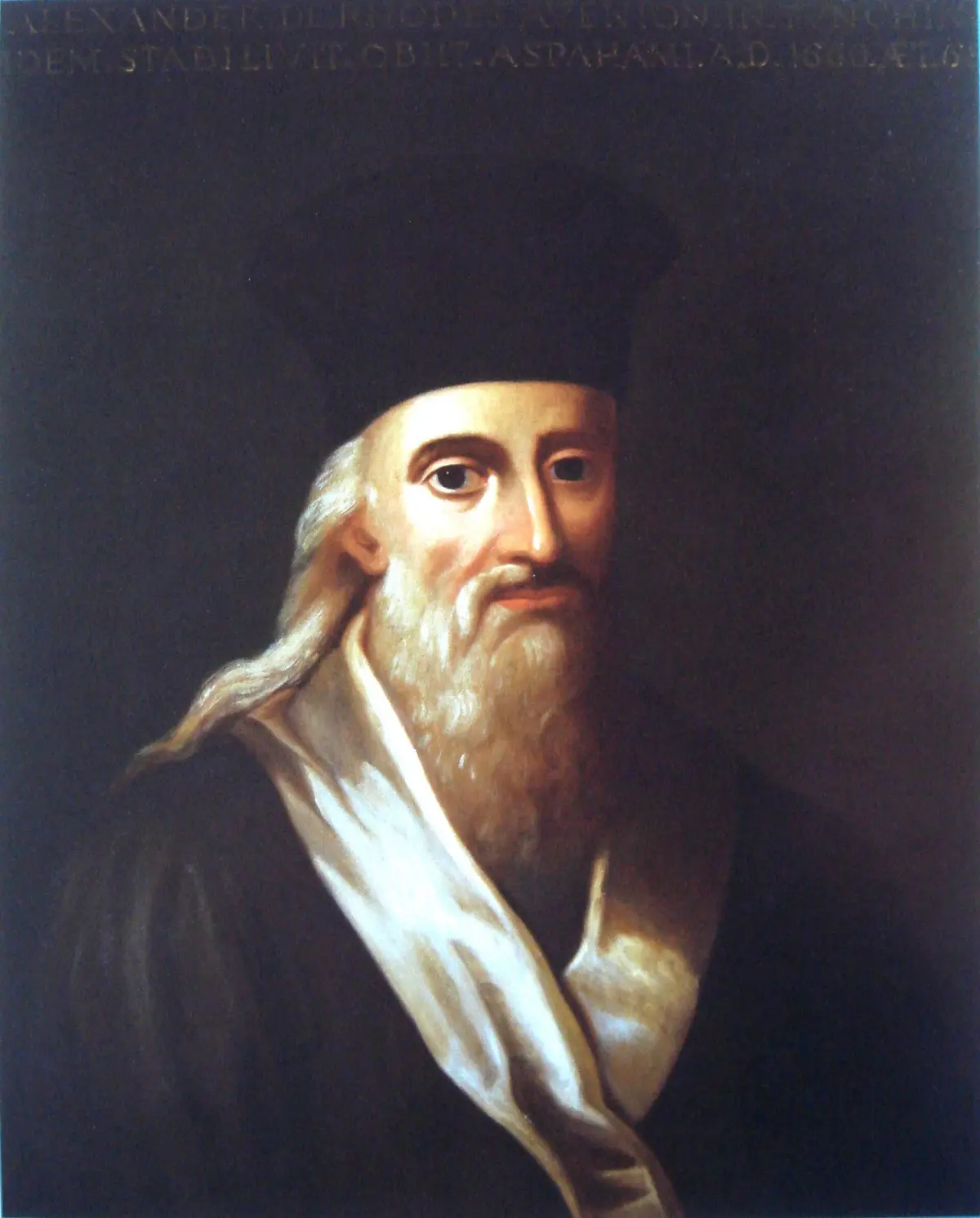
The most famous of these Jesuits was Alexandre de Rhodes (1593–1660), from Avignon. Arriving in 1624, he learned Vietnamese so well that he preached in it within months. Building on the work of Portuguese Jesuits such as Francisco de Pina, he helped develop a way of writing Vietnamese in the Latin alphabet, with marks for its tones. In 1651 he published in Rome a Vietnamese-Portuguese-Latin dictionary and a catechism in Vietnamese and Latin.
That writing system, quốc ngữ, eventually replaced Chinese characters and is how Vietnamese is written today, a lasting gift of the Jesuit mission to a whole nation.
Catechists and Martyrs
De Rhodes knew that foreign priests could be expelled at any moment. He trained a body of dedicated lay catechists, men who lived in community, taught the faith and baptized. One of them, Blessed Andrew of Phú Yên, a young catechist, was killed in 1644 and is honored as Vietnam’s protomartyr; he was beatified in 2000.
Persecutions followed for more than two centuries. Thousands of Vietnamese Catholics were killed. In 1988, Pope John Paul II canonized 117 Martyrs of Vietnam, including St. Andrew Dũng-Lạc, a priest, together with bishops, priests, catechists and lay men and women. Their feast is November 24. Read their story: St. Andrew Dũng-Lạc and the Martyrs of Vietnam.
After 1975
After the war ended in 1975, the Vietnamese Jesuits, then a young mission, were largely cut off from the rest of the Society. Some were imprisoned, and it became very hard to train or ordain new members. Fr. Nguyen described in his interview how Catholics kept their faith and how young men still sought to join the Society in secret.
A Growing Province
Since then, conditions have slowly improved. Vietnamese Jesuits became a full province in 2007 and are now among the fastest-growing Jesuit communities in the world, with many novices and young Jesuits serving in Vietnam and abroad. Vietnam today has one of the largest Catholic populations in Asia.
Prayer to the Vietnamese Martyrs (Original Prayer)
Holy Martyrs of Vietnam, St. Andrew Dũng-Lạc and companions, you held fast to Christ through prison and death. Pray for the Church in Vietnam, for its families, catechists, priests and religious, and for all Christians who suffer for their faith. Amen.
Continue Reading
Read about St. Andrew Dũng-Lạc and the Martyrs of Vietnam, Matteo Ricci, or the true story behind Silence.
Frequently asked questions
Who was Alexandre de Rhodes?
A French Jesuit from Avignon (1593–1660) who worked in Vietnam from 1624 to 1645, mastered the language, compiled a Vietnamese-Portuguese-Latin dictionary (1651) and a catechism, and helped standardize the Latin-script alphabet now used for Vietnamese.
Are there many Catholics in Vietnam today?
Yes. Vietnam has one of the largest Catholic populations in Asia, about 7 percent of its people, with many vocations to the priesthood and religious life.
Sources
- Stefan Taeubner, SJ, "A Return, The Society in Vietnam" (interview with Fr. Joseph Doan Cong Nguyen, SJ), Company magazine (Fall 1995)
- Peter C. Phan, Mission and Catechesis, Alexandre de Rhodes and Inculturation in Seventeenth-Century Vietnam (Orbis, 1998)
- Pope St. John Paul II, homily for the canonization of the Vietnamese Martyrs (June 19, 1988)