St. Josaphat: Life, Feast Day (November 12) & Prayer
Quick answer
St. Josaphat Kuntsevych (c. 1580-1623) was a Ruthenian Basilian monk and Archbishop of Polotsk who worked for the union of the Eastern Church with Rome. He was killed by a mob in Vitebsk on November 12, 1623, and canonized in 1867. His feast is November 12, and he is a patron of unity between Eastern and Western Christians.
Key takeaways
- St. Josaphat was born Ivan Kuntsevych around 1580 in Volodymyr, Volhynia, in today's Ukraine, into a family of the Byzantine tradition.
- He became a Basilian monk in Vilnius in 1604 and worked to renew Eastern monastic life with Joseph Velamin Rutsky.
- As Archbishop of Polotsk from 1618 he rebuilt his diocese and promoted the Union of Brest, which joined the Ruthenian Church to Rome.
- He was martyred in Vitebsk on November 12, 1623, and was canonized by Pope Pius IX in 1867.
- His feast is November 12, and he is honored as a patron of unity between the Eastern and Western Churches.
St. Josaphat Kuntsevych (c. 1580-1623) was an Eastern Catholic monk and Archbishop of Polotsk who gave his life for the unity of the Church. A Ruthenian of the Byzantine tradition, he worked to bring his people into full communion with the Bishop of Rome, and he was killed by a mob in Vitebsk on November 12, 1623. His feast is November 12, and he is honored as a patron of unity between Eastern and Western Christians.
He is not well known in many American parishes, yet his story speaks directly to a wound Christ Himself prayed to heal: the division of His followers. Here is his life, why the Church honors him, and how to pray with him on his feast.
Who Was St. Josaphat?
St. Josaphat was born around 1580 in Volodymyr, in the region of Volhynia, then part of the Polish-Lithuanian Commonwealth and today in western Ukraine. His baptismal name was Ivan (John). His family belonged to the Ruthenian Church, the Christians of today’s Ukraine and Belarus who worshiped in the Byzantine tradition, with the Divine Liturgy in Church Slavonic.
As a young man he was sent to Vilnius to learn the merchant’s trade. He did well at business, but his heart was elsewhere. He spent long hours in church, learned the Slavonic services by heart, and turned down both a partnership and a marriage that his employer offered him.
Key Dates in the Life of St. Josaphat
| Year | Event |
|---|---|
| c. 1580 | Born Ivan Kuntsevych in Volodymyr, Volhynia |
| 1595-1596 | Union of Brest: the Ruthenian bishops enter communion with Rome |
| 1604 | Enters the Holy Trinity Monastery in Vilnius and takes the name Josaphat |
| 1609 | Ordained a priest |
| 1617 | Named bishop, as coadjutor to the Archbishop of Polotsk |
| 1618 | Becomes Archbishop of Polotsk |
| November 12, 1623 | Martyred in Vitebsk |
| 1643 | Beatified by Pope Urban VIII |
| 1867 | Canonized by Pope Pius IX |
The Union of Brest: The Background to His Life
To understand St. Josaphat, you need to know about the Union of Brest. For centuries the Christians of Kyiv and its lands had been part of the Eastern Church, which had drifted out of communion with Rome after the break of 1054. In 1595-1596, most of the Ruthenian bishops chose to restore full communion with the Pope.
They did not become “Latin” Catholics. They kept their own liturgy, their married priests, their calendar and their spiritual traditions. They are the ancestors of today’s Ukrainian Greek Catholic Church and the Belarusian Greek Catholic Church. The Church teaches that this variety of rites is a treasure, not a problem: the Eastern and Western traditions together express the one Catholic faith (CCC 1200-1203).
The union was not accepted by everyone. Many clergy, monks and lay people, along with powerful nobles, stayed loyal to the Orthodox Church and saw the union as a betrayal. Josaphat grew up in the middle of this painful division, and he gave his whole life to healing it.
Monk, Priest and Reformer
In 1604, at about age 24, Ivan entered the Basilian monastery of the Holy Trinity in Vilnius, a house that had joined the union. He took the religious name Josaphat. The Eastern monks follow the rule of St. Basil the Great, which is why they are called Basilians.
He lived a life of severe penance, fasting and long nights of prayer. Together with his friend Joseph Velamin Rutsky, later Metropolitan of Kyiv, he worked to renew monastic life, and the Basilian Order of Ruthenian monks grew out of their reform. Ordained a priest in 1609, Josaphat became known as a preacher and confessor. People of every class came to him, and he drew many back to the sacraments.
He also became superior (archimandrite) of several monasteries. He insisted on careful celebration of the Byzantine liturgy and taught his monks to love their own Eastern heritage while remaining united with Rome.
Archbishop of Polotsk (1618-1623)
In 1617 Josaphat was consecrated bishop as coadjutor of Polotsk, in today’s Belarus, and the next year he became its archbishop. He found the diocese in poor shape: churches in ruins, clergy poorly trained, and many married priests struggling to support their families.
He set to work. He rebuilt churches, held synods for his priests, gave them written rules for their ministry, visited parishes across his territory, and gave generously to the poor. He kept the Eastern traditions, including married clergy, and asked his priests above all to be faithful pastors.
His work met fierce resistance. In 1620 a rival Orthodox hierarchy was consecrated, and a rival Archbishop of Polotsk, Meletius Smotrytsky, was named. Several towns, including Vitebsk, turned against Josaphat. Historians note that some contemporaries, among them the Lithuanian chancellor Lew Sapieha, rebuked him for being too firm and for relying on civil authorities against his opponents. The Church does not canonize anyone for every decision they made, but for heroic faith and charity, and in Josaphat’s case for dying as a martyr.
The Martyrdom of St. Josaphat
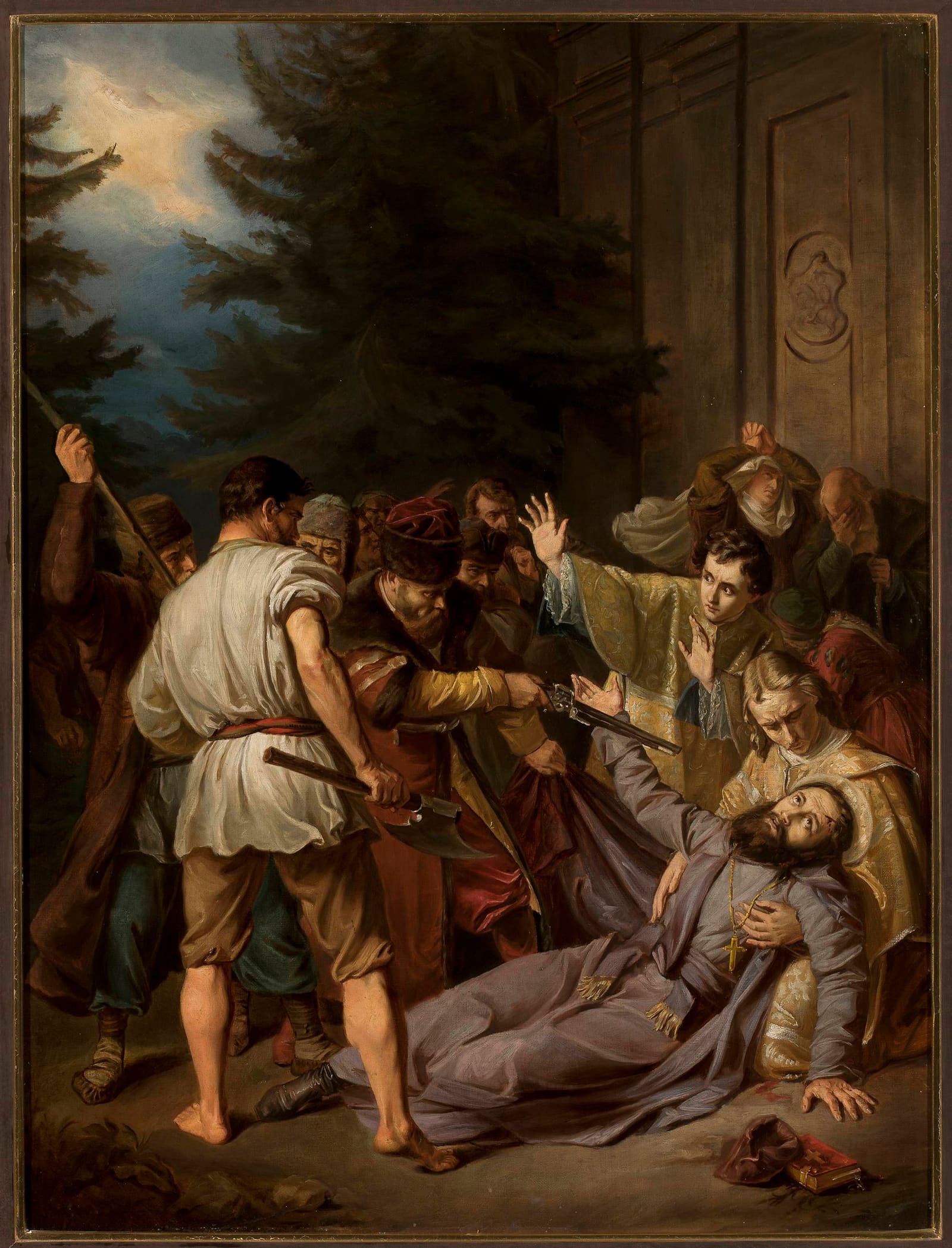
Josaphat knew his life was in danger. He went to Vitebsk anyway, to visit his people and preach. On November 12, 1623, a crowd stirred up against him broke into his residence. When they began beating his servants, he came out to face them and asked them to spare his household. He was struck down, shot, and his body was thrown into the Dvina River. He was about 43 years old.
His body was later recovered. In the centuries that followed, his relics were moved several times during wars and persecutions. Today they rest in St. Peter’s Basilica in Rome, a sign that this Eastern bishop belongs to the whole Church.
His death had a surprising effect. Many people were moved to reconsider the union, and Meletius Smotrytsky himself, the rival archbishop, later entered communion with Rome.
Why the Church Honors St. Josaphat
The Church honors St. Josaphat as a martyr for the unity of the Church. He was beatified in 1643 and canonized by Pope Pius IX in 1867. In 1923, on the 300th anniversary of his death, Pope Pius XI dedicated an encyclical to him, Ecclesiam Dei, and presented him as a model for all who work for reunion between East and West.
His life recalls the prayer of Jesus at the Last Supper, “so that they may all be one” (John 17:21). The Catechism teaches that the desire to recover the unity of all Christians is a gift of Christ and a call of the Holy Spirit (CCC 820). It also asks us to treat our separated brothers and sisters with respect and love (CCC 818). Today the Church pursues unity through prayer, dialogue and friendship, not force, and Josaphat’s sacrifice reminds us how costly division is.
What Is St. Josaphat the Patron Saint Of?
St. Josaphat is honored as a patron of:
- Unity between the Eastern and Western Churches, and of Christian unity in general.
- Ukrainian and Belarusian Catholics, especially the Eastern Catholic Churches of the Byzantine tradition, who love him as their own saint.
- Pastors and bishops who suffer for their flocks, since he laid down his life for his people.
Many Ukrainian Catholic parishes and a Ukrainian Catholic eparchy in the United States are named for him.
St. Josaphat Feast Day: How to Celebrate November 12
The feast of St. Josaphat is November 12, a memorial in the General Roman Calendar. Before the calendar reform of 1969, it was kept on November 14. Byzantine Catholics also honor him in their own liturgical calendars.
Simple ways to keep his feast:
- Go to Mass or the Divine Liturgy. If there is a Ukrainian or other Eastern Catholic parish near you, this is a beautiful day to visit.
- Pray for Christian unity, using one of the prayers below.
- Pray for Ukraine and Belarus, and for Christians who suffer for their faith.
- Learn about the Eastern Churches. Read about Sts. Cyril and Methodius, who brought the Gospel to the Slavic peoples centuries before Josaphat.
- Make peace with someone from whom you are divided, in your family or your parish.
The day before is the feast of St. Martin of Tours, another bishop who loved the poor and suffered opposition for the Gospel.
Prayers to St. Josaphat
Collect for the Memorial of St. Josaphat (Roman Missal)
Stir up in your Church, we pray, O Lord,
the Spirit that filled Saint Josaphat
as he laid down his life for the sheep,
so that through his intercession
we, too, may be strengthened by the same Spirit
and not be afraid to lay down our life for others.
Through our Lord Jesus Christ, your Son,
who lives and reigns with you in the unity of the Holy Spirit,
one God, for ever and ever.
Amen.
Prayer to St. Josaphat for Christian Unity (Original Prayer)
St. Josaphat, faithful shepherd and martyr,
you loved the Church of the East and the Church of Rome
and gave your life that they might be one.
Pray for all who bear the name of Christ.
Heal the wounds of our divisions,
soften hearts that are hardened by old quarrels,
and teach us to seek unity in truth and in charity.
May we see the day when all Christians
gather at one table of the Lord.
Amen.
Prayer to St. Josaphat for Ukraine and Persecuted Christians (Original Prayer)
St. Josaphat, son of Volhynia and pastor of your people,
look with love on Ukraine and Belarus,
and on every land where Christians suffer.
Obtain for them courage, peace and protection.
Comfort the grieving, strengthen the persecuted,
and bring an end to violence and war.
Through your prayers, may the blood of martyrs
become the seed of reconciliation.
Amen.
What Can We Learn from St. Josaphat Today?
Unity is worth our lives. Jesus did not pray for a loose friendship among His followers but that they would be one, as He and the Father are one. Josaphat took that prayer seriously enough to die for it. We can at least pray for it daily.
Love your own tradition and the whole Church. Josaphat was fully Eastern and fully Catholic. He shows that being united with the Pope does not mean giving up the beauty of one’s own liturgy and heritage.
A good shepherd stays with his flock. He went to Vitebsk knowing the danger. “A good shepherd lays down his life for the sheep” (John 10:11). Parents, grandparents and parish leaders are called to the same steady, sacrificial love.
Holiness is not the same as never making mistakes. Even admirers of Josaphat admit he could be hard on his opponents. The saints are honored for their faith, love and perseverance, and they encourage us that God can make saints out of real, imperfect people.
St. Josaphat, pray for us, and pray for the unity of the Church.
Frequently asked questions
When is the feast day of St. Josaphat?
St. Josaphat's feast is November 12, the day of his martyrdom in 1623. It is a memorial in the General Roman Calendar. Before the calendar reform of 1969 it was celebrated on November 14. Ukrainian and other Byzantine Catholics also honor him in their own calendars, and many Ukrainian Catholic parishes keep the day with special solemnity.
What is St. Josaphat the patron saint of?
St. Josaphat is honored as a patron of unity between the Eastern and Western Churches and of Christian unity in general. He is especially dear to Ukrainian and Belarusian Catholics of the Byzantine tradition. Because he gave his life for his flock as Archbishop of Polotsk, he is also a model for bishops and pastors.
How did St. Josaphat die?
On November 12, 1623, a crowd opposed to the union with Rome attacked his residence in Vitebsk, in today's Belarus. Josaphat went out to face them and asked them to spare his servants. He was struck down and shot, and his body was thrown into the Dvina River. He was about 43 years old.
Where are the relics of St. Josaphat?
After his death, his body was recovered from the river and venerated in his homeland. Over the centuries his relics were moved several times during wars and persecutions. Today they rest in St. Peter's Basilica in Rome, a sign that this Eastern Catholic martyr belongs to the whole Church, East and West.
Was St. Josaphat Catholic or Orthodox?
He was a Catholic of the Byzantine tradition. He belonged to the Ruthenian Church, which had entered full communion with Rome at the Union of Brest in 1595-1596 while keeping its Eastern liturgy and customs. Today his spiritual heirs are the Ukrainian and Belarusian Greek Catholic Churches.
Sources
- Pope Pius XI, Ecclesiam Dei (1923), encyclical on St. Josaphat
- John 17:21; John 10:11
- Catechism of the Catholic Church 818-822 (unity of the Church), 1200-1203 (liturgical traditions)
- Roman Missal, Memorial of St. Josaphat, November 12