Across the Rockies: The Jesuit Missions of the American West
Quick answer
In the 19th century Jesuits played a major role in the Catholic history of the American West. Belgian-born Fr. Pierre-Jean De Smet began the Rocky Mountain Mission among the Flathead (Salish) people in 1841. From 1848 about 350 Italian Jesuits, exiled during Italy's unification, came to the United States, most of them to the West. They ran missions among Native peoples in Montana, Idaho and Washington, founded colleges such as Santa Clara, Gonzaga and the forerunner of Regis University, and published a Spanish-language Catholic newspaper in New Mexico.
Key takeaways
- Fr. Pierre-Jean De Smet founded St. Mary's Mission in Montana in 1841.
- About 350 Italian Jesuits, exiled from Italy, came to America from 1848.
- They built missions such as St. Ignatius (Montana) and Sacred Heart (Idaho).
- They founded Santa Clara (1851), Gonzaga (1887) and Las Vegas College (1877), now Regis.
- Their work shaped Catholic life in eleven Western states.
“Once I thought to write a history of the immigrants in America. Then I discovered that the immigrants were American history.” Company magazine quoted the historian Oscar Handlin to open its story of a forgotten group of immigrants: the Jesuits who crossed the Rockies in the 19th century and helped build the Catholic Church in the American West.
Father De Smet and the Black Robes
The story begins with the Salish (Flathead) people of Montana. Iroquois Catholics who had settled among them told them about the “Black Robes,” the Jesuit priests. Between 1831 and 1839 the Salish sent four delegations on the long journey to St. Louis to ask for missionaries.
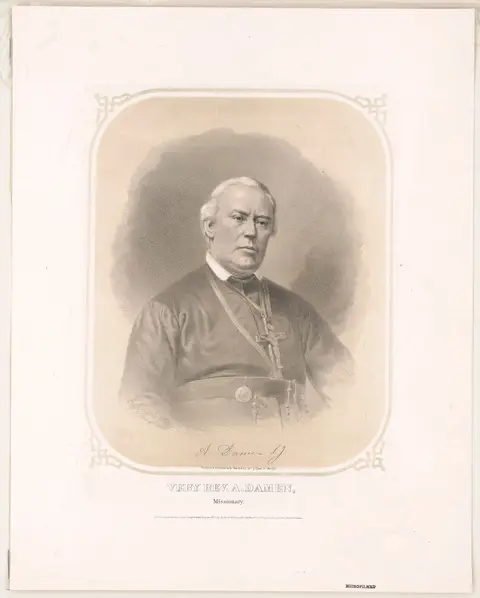
In 1840 the Belgian-born Jesuit Fr. Pierre-Jean De Smet answered. In 1841 he founded St. Mary’s Mission in the Bitterroot Valley of Montana, the first permanent Catholic mission in the Northwest. De Smet traveled tirelessly, perhaps 180,000 miles in his lifetime, and was so trusted by Native leaders that the U.S. government asked him to help negotiate peace, including with the Lakota leader Sitting Bull in 1868.
The Rocky Mountain Mission
De Smet’s work grew into the Rocky Mountain Mission, a vast network of missions, schools and churches among the peoples of today’s Montana, Idaho, Washington and Oregon: the Salish, Kalispel, Coeur d’Alene, Blackfeet, Nez Perce, Yakama, Crow and others.
The Mission of the Sacred Heart at Cataldo, Idaho, built by Coeur d’Alene people under the direction of the Italian Jesuit Fr. Antonio Ravalli in the early 1850s without a single nail, is today the oldest standing building in Idaho. St. Ignatius Mission in Montana, founded in 1854, became famous for its boarding schools for boys and girls, its kindergarten, printing press, workshops and farms.
Exiles From Italy
From 1848, revolutions and the movement for Italian unification led governments in Piedmont, Naples and elsewhere to expel the Jesuits. About 350 Italian Jesuits came to the United States, and most went west. In 1854 the Jesuits of the Turin Province adopted the Pacific Coast as their mission field.
Historian Fr. Gerald McKevitt, SJ, wrote in Company that the Italians’ gift for languages and their lack of loyalty to any American faction made them trusted by tribes alienated by harsh U.S. policies. By 1896 the Indian schools of the Rocky Mountain Mission enrolled more than a thousand students. Women religious, such as the Ursulines in Montana, ran many of the schools for girls.
Colleges for the West
The Italians also built schools for settlers:
- Santa Clara College, California, founded in 1851 at an old Franciscan mission, today Santa Clara University.
- St. Ignatius College in San Francisco (1855), today the University of San Francisco.
- Gonzaga College in Spokane, founded in 1887, today Gonzaga University.
- Las Vegas College in New Mexico, opened in 1877 by Jesuits from Naples, teaching in English and Spanish. It later moved to Denver and became Regis University.
The Southwest
In 1867 Jesuits of the Naples Province began the New Mexico–Colorado Mission, serving largely Hispanic Catholics. In 1875 they launched a Spanish-language weekly, the Revista Católica, modeled on the Jesuits’ Roman journal La Civiltà Cattolica. It shaped Catholic opinion in the region for 87 years.
A Mixed and Living Legacy
The Western missions were part of a painful period for Native peoples, marked by broken treaties, loss of land and, later, government boarding schools whose harms the Church has acknowledged and asked forgiveness for. The missionaries also learned Native languages, defended tribes against injustice and left communities of faith that endure. Jesuits still serve the parish of St. Ignatius, Montana, and the Sacred Heart Mission church in Idaho today.
Prayer for the Native Peoples of America (Original Prayer)
Great Spirit and Father of all, You spoke to the first peoples of this land through creation. Bless the Native nations of America. Heal the wounds of the past, strengthen their families and their faith, and help us all walk together in justice and peace, in the name of Jesus, our Lord. Amen.
Continue Reading
Read about the Jesuits in the United States, Father Eusebio Kino, or St. Isaac Jogues.
Frequently asked questions
Who was Father De Smet?
Pierre-Jean De Smet (1801–1873) was a Belgian-born Jesuit missionary who traveled tens of thousands of miles among the Native peoples of the plains and the Rockies, founded the Rocky Mountain Mission and was trusted as a peacemaker by both tribal leaders and the U.S. government.
What is the oldest building in Idaho?
The Mission of the Sacred Heart at Cataldo, built by Coeur d'Alene people under Jesuit direction between about 1850 and 1853, is the oldest standing building in Idaho.
Why did Italian Jesuits come to America?
During the Risorgimento, the movement for Italian unification, governments in several Italian states expelled the Jesuits and seized their houses. Many of the exiles volunteered for the American missions.
Sources
- Gerald McKevitt, SJ, "Across the Rockies," Company magazine (Summer 2001)
- Gerald McKevitt, SJ, Brokers of Culture, Italian Jesuits in the American West, 1848–1919 (Stanford University Press, 2007)
- Hiram M. Chittenden and Alfred T. Richardson, Life, Letters and Travels of Father Pierre-Jean De Smet (1905)