What Does Archangel Michael Look Like? Scripture, Art and Church Teaching
Quick answer
Archangel Michael has no physical appearance, because angels are pure spirits without bodies (CCC 328-330), and the Bible never describes his looks. Christian art shows him as a winged warrior in armor with a sword, sometimes scales, defeating a dragon, symbols drawn from his role in Scripture as leader of God's angels against Satan (Revelation 12:7-9).
Key takeaways
- Angels are pure spirits without bodies, so St. Michael has no physical appearance of his own (CCC 330).
- Scripture names Michael five times but never describes how he looks.
- His sword, armor, wings and the dragon at his feet are artistic symbols of his victory over Satan in Revelation 12.
- The scales for weighing souls are a medieval artistic tradition, not a teaching of Scripture.
- The best-known prayer to him is the Prayer to St. Michael the Archangel by Pope Leo XIII.
This article contains affiliate links: we may earn a commission if you buy through them, at no extra cost to you.
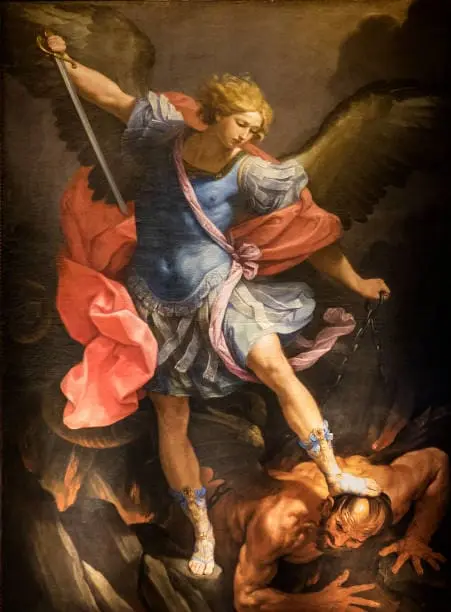
Archangel Michael has no physical appearance, because angels are pure spirits without bodies (CCC 328-330). The Bible never describes what Michael looks like. The familiar image of a winged warrior in armor, holding a sword and trampling a dragon, comes from Christian art, which draws on what Scripture says he does: he leads God’s angels against Satan (Revelation 12:7-9).
That image is still worth knowing well. It helps many Catholics picture St. Michael when they ask for his help, and each part of it says something true about him. Below we look at what the Church teaches, what Scripture says, and what each element of his traditional image means.
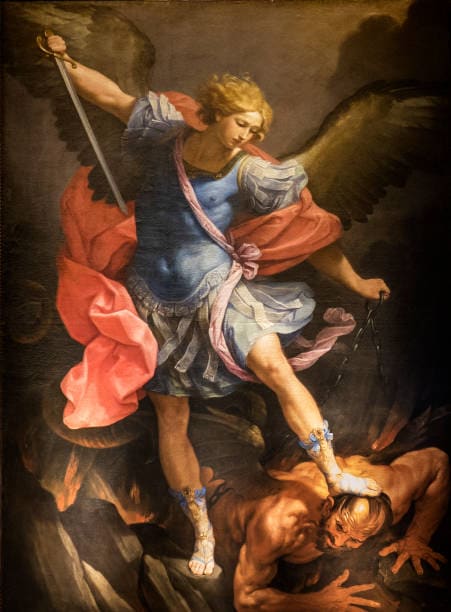
Rome, Italy: this painting in the church of the Immaculate Conception (Santa Maria della Concezione dei Cappuccini) shows the Archangel Michael defeating the devil. Painted by Guido Reni in 1636.
Do Angels Have Bodies? What the Church Teaches
The Catechism teaches that the existence of angels is a truth of faith, witnessed by Scripture and Tradition (CCC 328). The word “angel” names their mission, not their nature: they are messengers of God (CCC 329). By nature they are “purely spiritual creatures” with intelligence and will, “personal and immortal creatures, surpassing in perfection all visible creatures” (CCC 330).
So Michael has no hair color, height or face of his own. When God sends an angel to people in Scripture, the angel may appear in a visible form suited to the mission. In the Book of Tobit, the archangel Raphael explains that what Tobias saw when he seemed to eat and drink “was a vision” (Tobit 12:19).
This is why every picture of St. Michael is a symbol, not a portrait. That is not a weakness. A good symbol can teach the truth about him more clearly than a photograph could.
What Does the Bible Say About St. Michael?
Michael is named five times in Scripture. None of these passages describes his looks, but together they tell us who he is. You can read more in our article on St. Michael the Archangel in the Bible.
| Passage | What it tells us |
|---|---|
| Daniel 10:13, 21 | Michael is “one of the chief princes” who helps God’s messenger |
| Daniel 12:1 | “Michael, the great prince, guardian of your people,” will arise in a time of distress |
| Jude 9 | “The archangel Michael” contended with the devil and said, “May the Lord rebuke you!” |
| Revelation 12:7-9 | “Michael and his angels battled against the dragon,” and the dragon was thrown down |
His name itself is a kind of portrait. In Hebrew, Mi-ka-El means “Who is like God?” It is a question with only one answer: no one. Michael’s whole identity is to point away from himself to God. Learn why the Church calls him the leader of the heavenly host in Who Is the Supreme Archangel?
How Is St. Michael the Archangel Depicted in Art?
Although Scripture does not describe him, St. Michael has been a central figure in Christian art since the early centuries. His image has stayed remarkably consistent, because each element comes from his role in Scripture.
Why Is Archangel Michael Depicted With a Sword?
As leader of the heavenly armies, Michael is shown with a sword, a symbol of God’s power and justice against the forces of evil. Some artists and devotional images show the sword shining with light or with a blue glow. That is an artistic and popular image, not something Scripture tells us.
In the early Christian centuries, the leaders of armies wore armor and carried swords. Since Michael leads God’s angels, artists painted him like a noble Roman commander.
The sword of St. Michael has inspired its own devotion. On our website you can read about the prayer to the 7 swords of St. Michael.
Why Does Archangel Michael Wear Armor?
As a warrior, Michael is shown wearing armor, usually a shining breastplate in the Roman style. Christians have also seen in it the spiritual armor St. Paul describes: “Put on the armor of God so that you may be able to stand firm against the tactics of the devil” (Ephesians 6:11). Michael’s armor reminds us of the faith, truth and righteousness that protect us in our own spiritual battles.
What Does Archangel Michael Hold in His Hands?
Archangel Michael is most often shown holding a sword in his right hand and scales in his left. There are many variations, though:
- A sword or a lance, sometimes used to pin down a dragon or the devil.
- A shield, often marked with the words “Quis ut Deus?” (“Who is like God?”).
- Scales, used to weigh souls.
- A trumpet, linked with the Last Judgment.
- A globe or orb, a sign of God’s rule over the world.
Does St. Michael Weigh Souls?
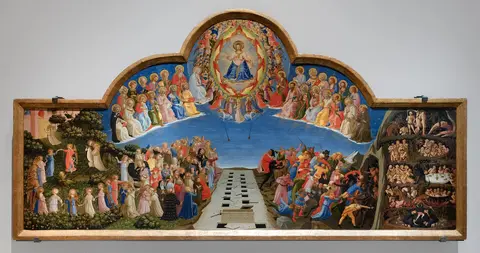
The scales are an artistic tradition, not a teaching of Scripture. The Bible never says Michael weighs souls. Medieval artists placed scales in his hand in paintings of the Last Judgment, such as Rogier van der Weyden’s altarpiece at Beaune, to show that he defends the faithful at the hour of death and at the judgment.
The Church does honor St. Michael as a protector of souls at the hour of death, and his intercession has long been sought by the dying. But judgment belongs to Christ alone.
Why Is Michael Shown With Wings and a Dragon?
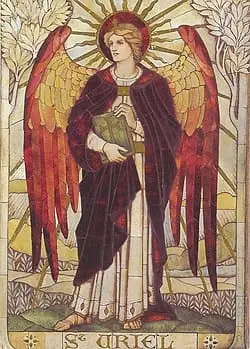
Wings are a sign that angels belong to heaven and carry out God’s will swiftly. The prophet Isaiah saw seraphim with six wings in his vision of God’s glory (Isaiah 6:2), and artists gave wings to all angels.
The dragon or serpent under his feet comes straight from Revelation 12:9: “The huge dragon, the ancient serpent, who is called the Devil and Satan,” was thrown down. Sometimes the devil is shown in a partly human form instead, as in Guido Reni’s painting above.
Famous Paintings of St. Michael
Two of the best-known works are:
- Guido Reni, St. Michael the Archangel (1636), in the Capuchin church of Santa Maria della Concezione in Rome. Michael, calm and graceful, holds a sword and a chain over the devil.
- Raphael, St. Michael Vanquishing Satan (1518), now in the Louvre in Paris. Michael descends with spear raised over the fallen devil.
These are works of art. They show what great painters understood about Michael’s victory, not what he “really” looks like.
What Color Represents Archangel Michael?
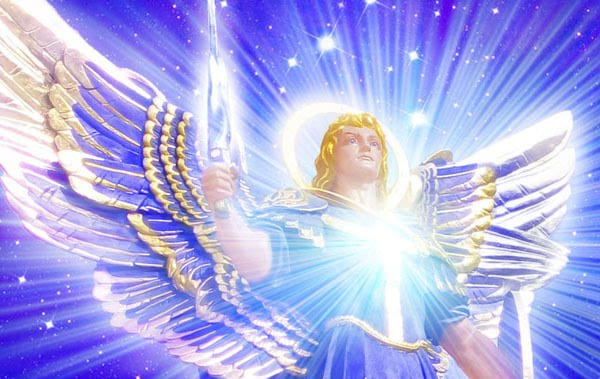
In many modern devotional images Michael is linked with blue, and some people light a blue candle when praying to Archangel Michael. This is a popular custom rather than a Church tradition. In older art Michael wears many colors, and red and gold are common. What matters is not the color of a candle but the faith with which we pray.
The Prayer to St. Michael the Archangel (Pope Leo XIII)
The best way to “see” St. Michael is to call on him. Pope Leo XIII composed this prayer in the 1880s and ordered it said after Low Mass. Pope St. John Paul II encouraged Catholics to pray it again, and many parishes now pray it after every Mass. For more prayers to him, see our Prayer to St. Michael the Archangel.
Prayer to St. Michael the Archangel
St. Michael the Archangel,
defend us in battle.
Be our protection against the wickedness and snares of the devil.
May God rebuke him, we humbly pray,
and do thou, O Prince of the heavenly hosts,
by the power of God,
thrust into hell Satan,
and all the evil spirits,
who prowl about the world
seeking the ruin of souls.
Amen.
A Warrior Who Is Also Gentle
The image of Michael is one of a bold yet gentle protector who stands against evil and for what is right. He is strong, but his strength is not his own: it is the power of God, whom he serves with complete humility. He is also one of the three archangels named in Scripture, honored with Gabriel and Raphael on September 29.
Many Catholics keep an image of the archangel at home as a reminder to ask for his prayers. The Catholic Company carries St. Michael statues and medals.
Frequently asked questions
Does the Bible describe what Archangel Michael looks like?
No. Michael is named in Daniel 10:13 and 21, Daniel 12:1, Jude 9 and Revelation 12:7, but none of these passages describes his appearance. They tell us what he does: he is a great prince who guards God's people, contends with the devil and leads the angels against the dragon. His appearance in art is built from these roles.
Why is St. Michael shown with scales?
The scales come from medieval paintings of the Last Judgment, where Michael is shown weighing souls. It is an artistic tradition, not something the Bible teaches. It expresses the Church's long trust in Michael as a defender of souls at the hour of death. Judgment itself belongs to Christ, who will judge the living and the dead.
Can angels take on a human appearance?
Angels are pure spirits and have no bodies of their own (CCC 330). When God sends them on a mission, they may appear in a visible form. In the Book of Tobit, the archangel Raphael travels with Tobias in human form, but later explains that what Tobias saw when he seemed to eat and drink was a vision (Tobit 12:19).
What does the name Michael mean?
Michael comes from the Hebrew Mi-ka-El, which means "Who is like God?" The question expects the answer "No one." It sums up Michael's role as the faithful angel who stood with God against the pride of Satan. The Latin form, Quis ut Deus?, is often written on his shield in Christian art.
Sources
- Catechism of the Catholic Church, 328-330
- Scripture: Daniel 10:13, 21; 12:1; Jude 9; Revelation 12:7-9; Tobit 12:19; Ephesians 6:11; Isaiah 6:2
- Pope Leo XIII, Prayer to St. Michael the Archangel (1886)