St. John Ogilvie: Jesuit Martyr of Scotland
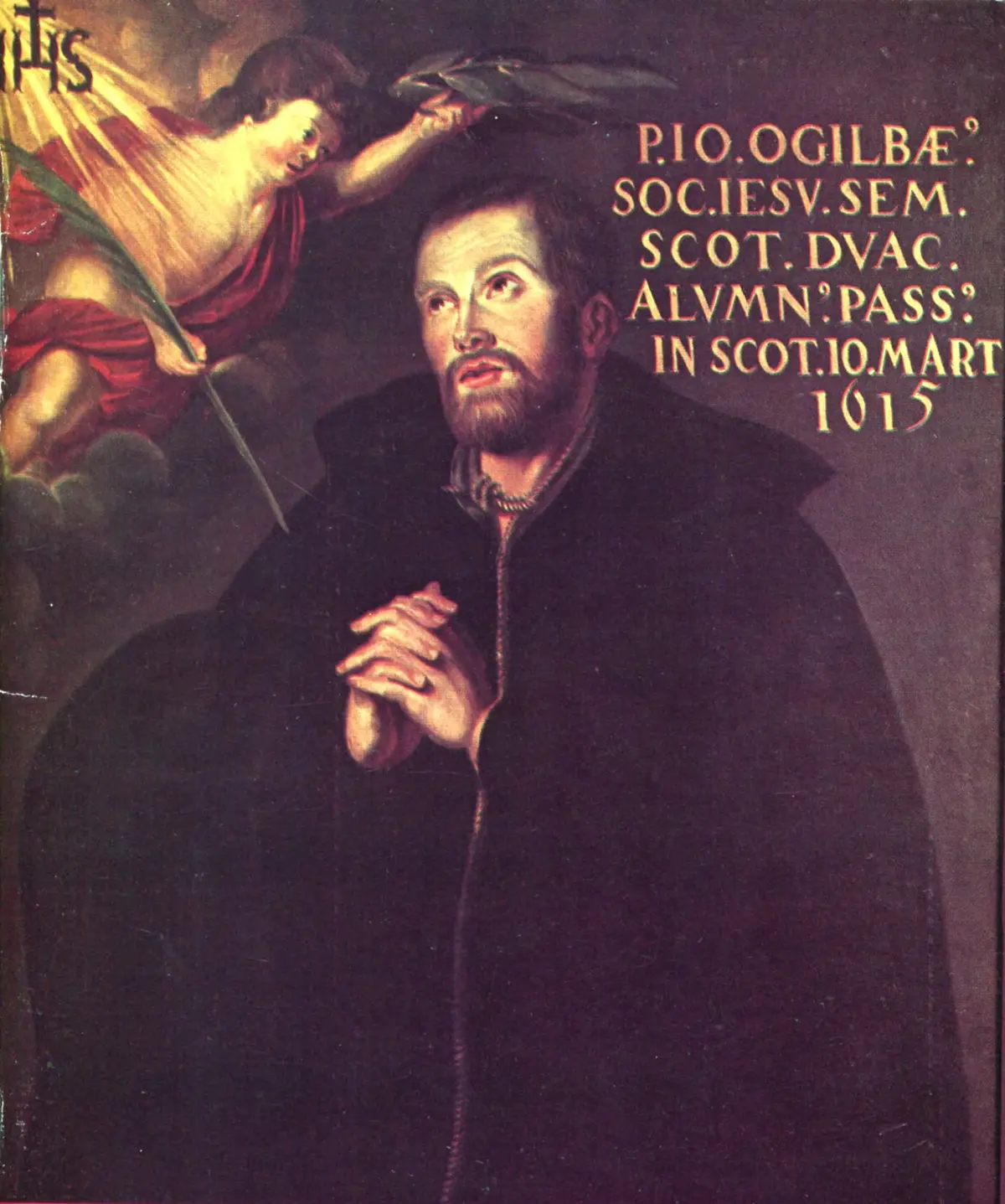
Quick answer
St. John Ogilvie (1579–1615) was born into a Calvinist noble family in Banffshire, Scotland, became a Catholic while studying in Europe, and joined the Jesuits. Ordained in 1610, he returned to Scotland in disguise in 1613 to minister to persecuted Catholics in Edinburgh and Glasgow. Betrayed in 1614, he was tortured with sleep deprivation and tried for treason for refusing to accept the king's spiritual authority. He was hanged in Glasgow on March 10, 1615. Canonized by Pope Paul VI in 1976, he is Scotland's only post-Reformation saint.
Key takeaways
- Born a Calvinist in Scotland in 1579, he became a Catholic in Europe at 17.
- He entered the Jesuits in 1599 and was ordained in Paris in 1610.
- He ministered secretly in Scotland from 1613 until his arrest in 1614.
- He was hanged in Glasgow on March 10, 1615, for refusing the king's spiritual supremacy.
- Pope Paul VI canonized him in 1976 after the healing of a Glasgow man.
On the morning of March 10, 1615, a large crowd gathered at Glasgow Cross to watch the hanging of a Catholic priest. Before he died, the young man threw his rosary into the crowd. According to the traditional account, it struck a young Calvinist nobleman from Hungary, Baron Johann von Eckersdorff, who later became a Catholic and credited the martyr’s witness. The priest was John Ogilvie, a 36-year-old Jesuit, and today he is Scotland’s only canonized saint since the Reformation.
A Calvinist Noble Family
John Ogilvie was born in 1579 at Drum-na-Keith in Banffshire, Scotland, the eldest son of a wealthy laird. His family was Calvinist, though some relatives remained Catholic. At 13 he was sent to the Continent for his education, as was common for Scottish nobles.
Conversion
In France and Belgium, young John met the religious debates of the day. He listened to Catholics and Protestants arguing about the faith. Moved especially by the courage of martyrs, he decided that the Catholic Church was the Church of Christ and was received into it at the Scots College in Louvain in 1596, at the age of 17.
Jesuit Priest
In 1599 he entered the Society of Jesus at Brno, in Moravia. He studied and taught in Austria and was ordained a priest in Paris in 1610. He longed to return to Scotland, where Catholics had been without priests for years and the Mass was outlawed. After repeated requests, his superiors agreed.
Secret Mission in Scotland
In 1613 Ogilvie entered Scotland disguised as a horse trader and soldier named John Watson. He moved between Edinburgh and Glasgow, secretly celebrating Mass in private homes, hearing confessions and bringing lapsed Catholics back to the sacraments. His ministry lasted less than a year.
Arrest and Torture
In October 1614 he was betrayed by a man pretending to want instruction in the faith and arrested in Glasgow. Archbishop John Spottiswoode, the Protestant archbishop of Glasgow, interrogated him. To make him reveal the names of Catholics, his captors kept him awake for eight days and nights, prodding him with pins and sticks. He refused to name anyone.
Ogilvie answered his interrogators with spirit and humor. He wrote an account of his imprisonment that was smuggled out of the prison.
Trial for Treason
Saying Mass was illegal, but the authorities wanted to make an example of him for treason. They asked whether the pope had spiritual authority over the king. Ogilvie answered that in temporal matters he would obey King James VI, but in spiritual matters the king had no authority over the Church, which belongs to the pope as the successor of Peter. For this he was condemned.
He was hanged at Glasgow Cross on March 10, 1615. His last recorded words included a plea for the prayers of any hidden Catholics in the crowd.
Canonization
Ogilvie was beatified in 1929. In 1967 a Glasgow man, John Fagan, was dying of stomach cancer. His parish prayed for Ogilvie’s intercession. Fagan recovered completely, and doctors could find no natural explanation. Pope Paul VI canonized St. John Ogilvie on October 17, 1976.
His Witness Today
St. John Ogilvie shows that conscience and faithfulness to the Church can cost everything, and that a martyr can face death with courage and even cheerfulness. He is a patron for Scottish Catholics and for all who suffer for their faith. Read about other Jesuit saints and blesseds and the Jesuit martyrs of the 20th century.
Prayer to St. John Ogilvie (Original Prayer)
St. John Ogilvie, faithful priest and martyr, you gave your life rather than deny the Church of Christ. Pray for the people of Scotland and for all who suffer for their faith. Give us courage to be loyal to Christ, charity toward those who differ from us, and the joy of a clear conscience. Amen.
Continue Reading
Read about Jesuit saints and blesseds, the life of St. Ignatius of Loyola, or Blessed Miguel Pro, another Jesuit martyr.
Frequently asked questions
When is the feast of St. John Ogilvie?
March 10, the anniversary of his martyrdom, is kept as his feast in Scotland.
Why was John Ogilvie executed?
Saying Mass was illegal, but he was condemned for high treason because he refused to acknowledge King James VI's spiritual authority over the Church, insisting that the pope was the head of the Church in spiritual matters while professing loyalty to the king in civil affairs.
What miracle led to his canonization?
In 1967 John Fagan, a Glasgow dock worker dying of stomach cancer, recovered completely after his family and parish prayed for Ogilvie's intercession. Medical experts could find no natural explanation, and Pope Paul VI canonized Ogilvie on October 17, 1976.
Sources
- "John Ogilvie SJ, Martyr of Scotland," Company magazine (Winter 2000)
- Relatio Incarcerationis (Ogilvie's own account of his imprisonment, 1615)
- Pope St. Paul VI, homily for the canonization of John Ogilvie (October 17, 1976)