King Solomon in the Bible: Wisdom, the Temple and a Warning
Quick answer
Solomon, son of David and Bathsheba, became king of Israel around 970 BC. When God offered him anything, he asked for a wise and understanding heart, and God gave him wisdom, riches and honor. He built the first Temple in Jerusalem. Late in life his many foreign wives led him to worship other gods, and after his death the kingdom split. Several books of the Bible, including Proverbs, Ecclesiastes, the Song of Songs and Wisdom, are traditionally linked with him.
Key takeaways
- At Gibeon, he asked God for "an understanding heart" to govern justly (1 Kings 3:9).
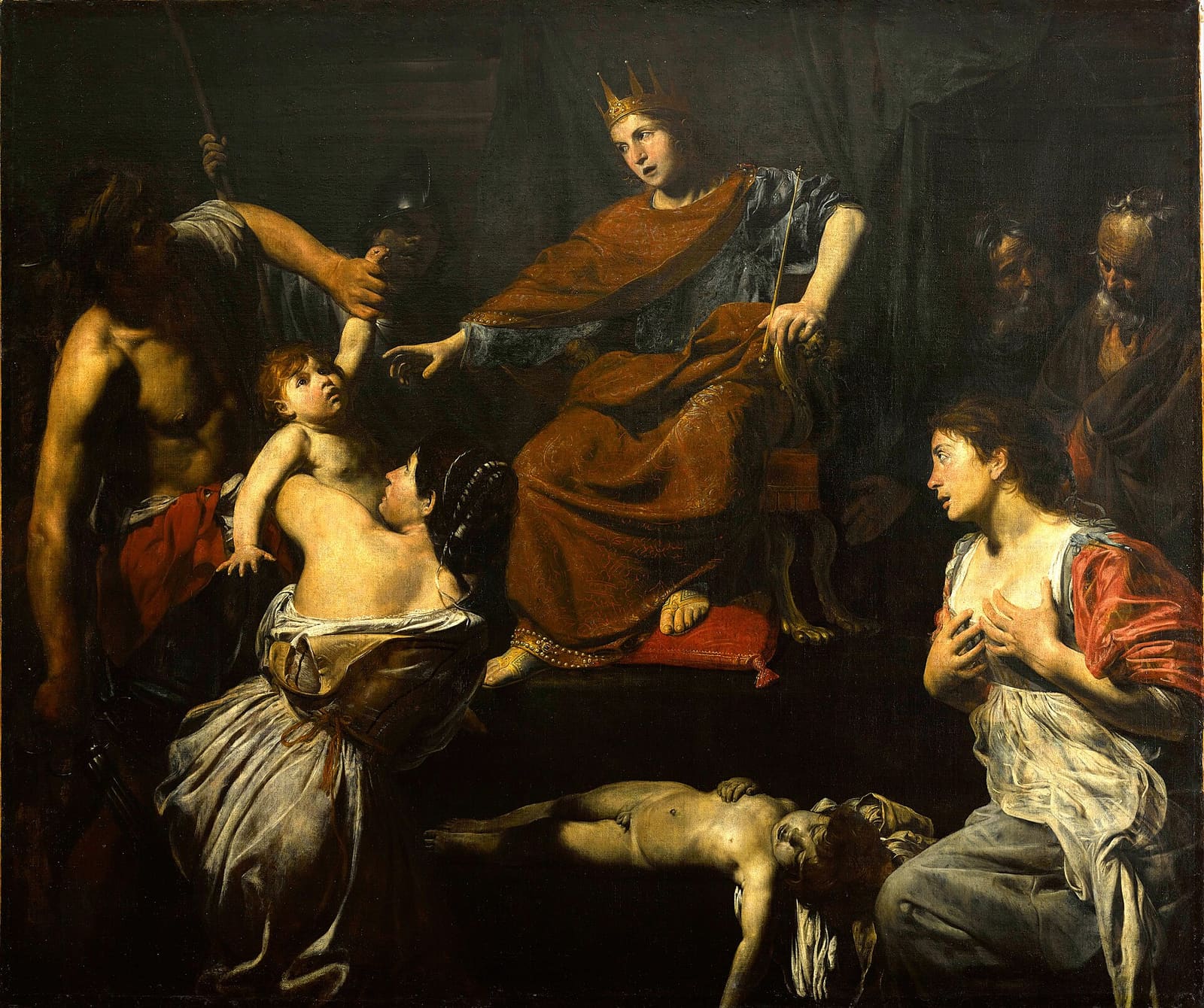
- His judgment between two women claiming the same baby became proverbial.
- He built and dedicated the Temple in Jerusalem with a great prayer (1 Kings 8).
- His decline shows that even great gifts can be lost through unfaithfulness.
King Solomon’s name has become a byword for wisdom. His story also contains one of the Bible’s most sobering warnings: even the wisest heart can drift away from God.
Son of David
Solomon was the son of King David and Bathsheba. Though not the eldest son, he was chosen by David as his heir, with the support of the prophet Nathan. He became king around 970 BC.
A Prayer for Wisdom
At the shrine of Gibeon, the Lord appeared to Solomon in a dream and said, “Ask what thou wilt that I should give thee.” Solomon, still young, asked:
Give therefore to thy servant an understanding heart, to judge thy people, and discern between good and evil. (1 Kings 3:9, Douay-Rheims 3 Kings 3:9)
God was pleased that he had not asked for long life, riches or the death of his enemies. He gave him wisdom, and riches and glory as well.
The Judgment of Solomon
Soon after, two women came before Solomon, each claiming the same baby. Solomon called for a sword and ordered the child cut in two. One woman agreed; the other begged him to give the child to her rival rather than let it die. Solomon knew she was the true mother (1 Kings 3:16-28). All Israel saw that the wisdom of God was in him.
The Temple
Solomon’s greatest work was the Temple in Jerusalem, built over seven years with cedar from Lebanon and gold. The Ark of the Covenant was brought into its inner sanctuary, and the cloud of God’s glory filled the house. Solomon prayed a long prayer of dedication, asking God to hear the prayers of all who pray toward that place, even foreigners (1 Kings 8).
Wealth and Fame
Solomon’s kingdom grew rich through trade. The Queen of Sheba came to test his wisdom and was amazed. Jesus Himself mentioned “Solomon in all his glory” and said that “a greater than Solomon is here” (Matthew 6:29; 12:42).
His Downfall
But Solomon married many foreign wives, and in his old age they turned his heart toward other gods. He built shrines for them. The Lord was angry and said the kingdom would be torn from his son (1 Kings 11). After Solomon’s death around 931 BC, the kingdom split into Israel in the north and Judah in the south.
What Solomon Teaches
Wisdom is a gift we should ask for, as Solomon did. But wisdom must be lived out in faithfulness. The Book of Wisdom, written in Solomon’s name, says that wisdom is “an infinite treasure to men” (Wisdom 7:14).
A Prayer for Wisdom (Original Prayer)
Lord, give me an understanding heart, to know what is right and to do it. Guide my decisions, guard my heart, and keep me faithful to You to the end. Amen.
Continue Reading
Read about his father, King David, the Book of Job, or our guide to the Catholic Bible.
Frequently asked questions
What did Solomon ask God for?
Wisdom. God was pleased and gave him wisdom, and also the riches and long life he had not asked for (1 Kings 3:5-14).
Which books of the Bible are associated with Solomon?
Proverbs, Ecclesiastes, the Song of Songs and the Book of Wisdom are traditionally linked with him, and several psalms (such as Psalm 71 [72] and 126 [127]) carry his name.
Is Solomon a saint?
The Church does not celebrate him with a feast. His wisdom and the Temple are honored, but Scripture also records his serious sins.
Sources
- 1 Kings 1–11 (Douay-Rheims 3 Kings 1–11); 2 Chronicles 1–9
- Book of Wisdom 7–9 (Douay-Rheims)
- Gospel of Matthew 6:29; 12:42 (Douay-Rheims)